

Imagine you are trying to buy a limited-edition sneaker online. The site sells out in seconds because bots are snapping them up faster than any human can click. Now, imagine that same bot technology is used not for shoes, but for buying Bitcoin on an exchange before the price jumps. This is where residential proxies come into play. These tools route your internet traffic through real home devices, making your automated trading look like normal user activity. For many crypto traders, this seems like the ultimate secret weapon. But is it? Or does it open a Pandora’s box of security risks and regulatory headaches?
In the fast-moving world of cryptocurrency, speed and anonymity are everything. Milliseconds can mean the difference between profit and loss. Residential proxies promise high-speed connections with stable ping rates, crucial for executing trades instantly. They also allow traders to manage multiple wallets or accounts from a single device without getting banned. However, as we move into 2026, the line between legitimate automation and market manipulation is blurring. Let’s break down how these proxies work, why they are effective, and the serious risks involved.
How Residential Proxies Work in Crypto Trading
To understand why residential proxies are so popular, you first need to know what makes them different from other types of proxies. Unlike datacenter proxies, which come from large server farms and are easily flagged by anti-bot systems, residential proxies use IP addresses assigned to actual household internet connections. When you use a residential proxy, your request looks like it’s coming from a regular person browsing the web from their living room.
This distinction is critical for crypto trading platforms. Exchanges like Binance, Coinbase, or Kraken have sophisticated detection systems designed to block automated bots that might manipulate prices or exploit glitches. If you use a standard datacenter proxy, these systems often detect the traffic pattern and ban your account. Residential proxies bypass this because the IP address appears legitimate. Each account you manage operates under a unique residential IP, making it hard for the platform to link them together.
There are two main ways these proxies operate:
- Sticky Sessions: Your connection stays tied to the same IP address for a set period, usually up to 30 minutes. This is useful if you need to log in, perform a series of actions, and stay logged in without interruption.
- Rotating Sessions: Your IP address changes with every request or action. This is ideal for high-frequency trading or scraping data from multiple sources quickly, as it prevents any single IP from being overwhelmed or flagged.
For example, if you are running an arbitrage bot that buys Bitcoin on one exchange and sells it on another for a small profit, rotating residential proxies ensure that neither exchange sees too much activity from a single location. This keeps your operation under the radar.
The Effectiveness: Why Traders Choose Residential Proxies
So, do residential proxies actually work for crypto trading? The short answer is yes, but with caveats. Industry experts consider them essential for certain legitimate operations, particularly automated arbitrage and rate monitoring. Here is why they are so effective:
| Feature | Residential Proxies | Datacenter Proxies |
|---|---|---|
| Detection Rate | Low (appears as real user) | High (easily flagged by anti-bots) |
| Speed/Latency | Moderate to High (depends on provider) | Very High (dedicated servers) |
| Anonymity Level | High (indistinguishable from humans) | Low (IP ranges are known) |
| Cost | Expensive ($300-$1,500+/month) | Cheaper ($10-$50/month) |
| Best Use Case | Multi-account management, arbitrage | Simple API calls, low-risk tasks |
Arbitrage Opportunities: Cryptocurrency markets are fragmented. Prices for the same asset can vary slightly between exchanges. A trader using residential proxies can monitor these differences across multiple platforms simultaneously. Because the proxies hide the fact that all requests are coming from the same source, the trader can execute trades on several exchanges without triggering fraud alerts.
Privacy and Security: Beyond just avoiding bans, residential proxies act as a shield against cyber-attacks. By hiding your real IP address, you reduce the risk of hackers targeting your specific location or device. This is especially important for high-net-worth individuals who might be targets for sophisticated attacks.
Account Management: Some traders prefer to spread their capital across multiple accounts to diversify risk or take advantage of new user bonuses. Residential proxies make this possible by assigning a unique IP to each account, preventing the exchange from linking them together.

The Risks: Fraud, Manipulation, and Regulatory Scrutiny
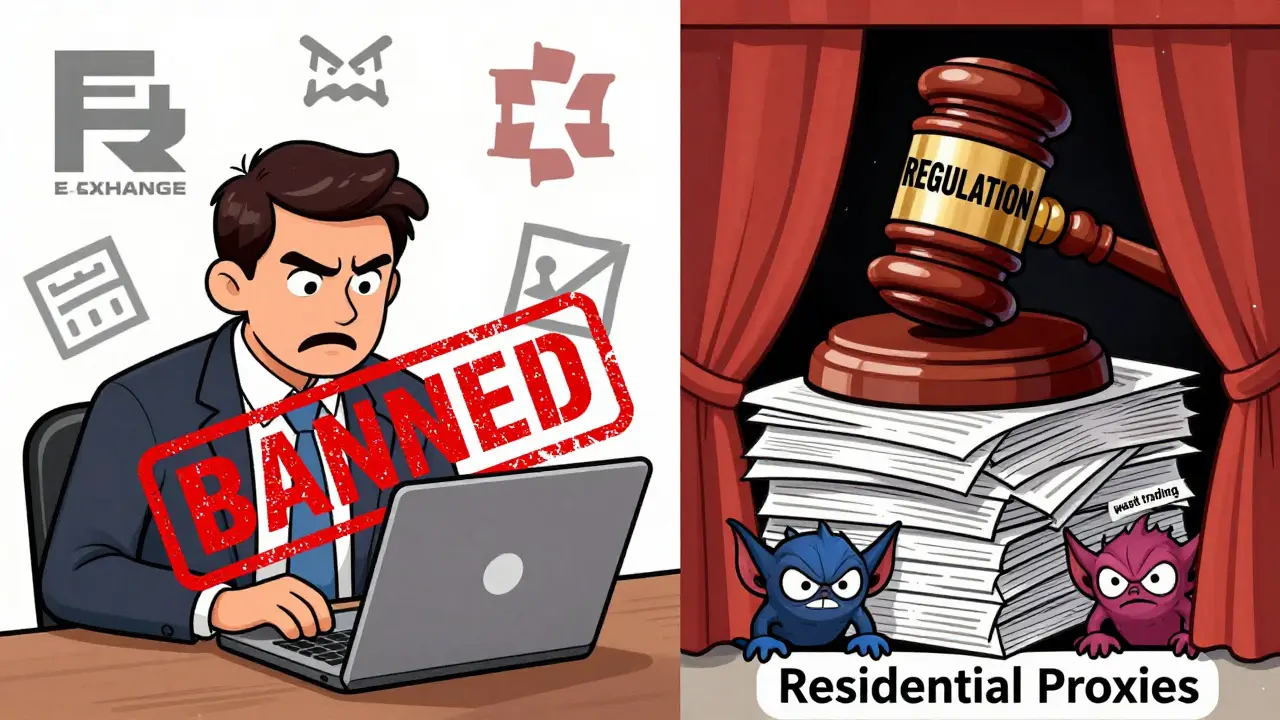
While the benefits sound appealing, the dark side of residential proxies in crypto trading is significant. The same features that protect legitimate traders also enable malicious actors to commit financial crimes. Cybersecurity experts warn that residential proxies are extensively used for credit card stuffing, money laundering, and market manipulation.
A 2022 analysis by Forbes examined 157 cryptocurrency exchanges and found that 51% of daily Bitcoin trading volume likely represented fraudulent activity. Residential proxies played a key role in this by facilitating wash trading-a practice where traders buy and sell assets to themselves to create fake volume and influence price movements. This manipulates the market, misleading other investors and potentially violating securities laws.
Here are the primary risks you need to be aware of:
- Regulatory Crackdowns: As governments around the world tighten regulations on cryptocurrency, they are also focusing on the tools used to evade oversight. By 2025, financial regulators are expected to introduce stricter compliance requirements for proxy usage in trading. Using residential proxies to hide your identity could lead to legal consequences if discovered.
- Platform Bans: Even if you are not committing fraud, exchanges are becoming smarter at detecting proxy usage. Advanced machine learning algorithms can analyze behavior patterns, such as mouse movements and typing speeds, to identify bots regardless of the IP address. If detected, your accounts could be permanently suspended, and funds frozen.
- Security Vulnerabilities: Not all proxy providers are trustworthy. Some may log your traffic or sell your data to third parties. In a worst-case scenario, a compromised proxy server could intercept your login credentials or private keys, leading to theft of your assets.
- Reputational Damage: Being associated with illicit activities, even indirectly, can harm your reputation in the crypto community. If your IP is linked to a scam or hack, you could face scrutiny from peers and regulators alike.
Underground forums reveal that criminals actively seek residential IP services for illicit banking and crypto-related activities. They use these proxies to purchase merchandise with stolen credit cards while appearing to operate from legitimate locations. This association taints the technology, making it harder for legitimate users to prove their innocence.
Navigating the Legal and Ethical Landscape
Given the risks, how can you use residential proxies responsibly? First, understand that legality varies by jurisdiction. In some countries, using proxies to access restricted trading platforms may violate local laws. Always consult with a legal expert before implementing complex proxy strategies.
Second, choose reputable providers. Companies like Bright Data, Oxylabs, and Smartproxy have established reputations and offer transparent policies about data usage. Avoid cheap, unknown providers that may compromise your security. Look for providers that emphasize compliance and ethical sourcing of IP addresses.
Third, be transparent with exchanges. If you are using proxies for legitimate reasons, such as protecting your privacy or managing multiple accounts for business purposes, consider disclosing this to the platform. While this may limit your ability to hide your activities, it reduces the risk of sudden bans or legal issues.
Finally, keep your software updated. Security threats evolve rapidly, and outdated proxy clients can leave you vulnerable to attacks. Regularly audit your setup to ensure that your connections remain secure and that your data is protected.
Future Outlook: What Lies Ahead for 2026 and Beyond?
The global proxy services market reached $1.8 billion in 2023 and is projected to grow at 13.5% annually through 2028. This growth is driven largely by demand from cryptocurrency trading clients. However, the future of residential proxies in this space will likely see a bifurcation. On one hand, regulated, compliant applications will continue to thrive, supported by improved security features and clearer guidelines. On the other hand, underground usage for illicit activities will persist, facing increased enforcement.
As detection technologies improve, the effectiveness of residential proxies may diminish for casual users. Platforms are investing heavily in AI-driven fraud detection that goes beyond simple IP blocking. This means that relying solely on proxies for anonymity will become less viable over time. Instead, traders will need to adopt a holistic approach to security, combining proxies with other best practices like multi-factor authentication and hardware wallets.
Ultimately, residential proxies are a powerful tool, but they are not a magic bullet. They require careful implementation, ongoing maintenance, and a clear understanding of the legal landscape. Used wisely, they can enhance your trading efficiency and protect your privacy. Used recklessly, they can lead to severe consequences. Stay informed, stay compliant, and always prioritize security.
Are residential proxies legal for crypto trading?
The legality depends on your jurisdiction and how you use them. Using proxies for privacy or legitimate automation is generally legal, but using them to evade regulations, commit fraud, or manipulate markets is illegal. Always check local laws and consult a legal professional.
Can crypto exchanges detect if I am using a residential proxy?
Yes, increasingly so. While residential IPs are harder to flag than datacenter ones, advanced AI systems can detect bot-like behavior patterns, such as rapid clicking or inconsistent mouse movements, regardless of the IP address. Exchanges are constantly improving their detection methods.
What is the cost of using residential proxies for crypto trading?
Prices vary widely based on volume and provider. High-volume trading operations typically cost between $300 and $1,500 per month. Cheaper options exist but may lack reliability or security, posing greater risks.
How do residential proxies help with arbitrage?
Arbitrage involves buying an asset on one exchange and selling it on another for a profit. Residential proxies allow you to access multiple exchanges simultaneously without triggering fraud alerts, as each request appears to come from a different, legitimate user location.
Is it safe to use free residential proxies for trading?
No, it is highly unsafe. Free proxies often lack security measures, may log your data, or be controlled by malicious actors. Using them for sensitive activities like crypto trading exposes your assets and personal information to significant risk.
What is wash trading, and how do proxies facilitate it?
Wash trading is the practice of buying and selling an asset to oneself to create artificial volume and influence price. Residential proxies mask the fact that multiple accounts belong to the same entity, allowing traders to execute these deceptive transactions without immediate detection.