
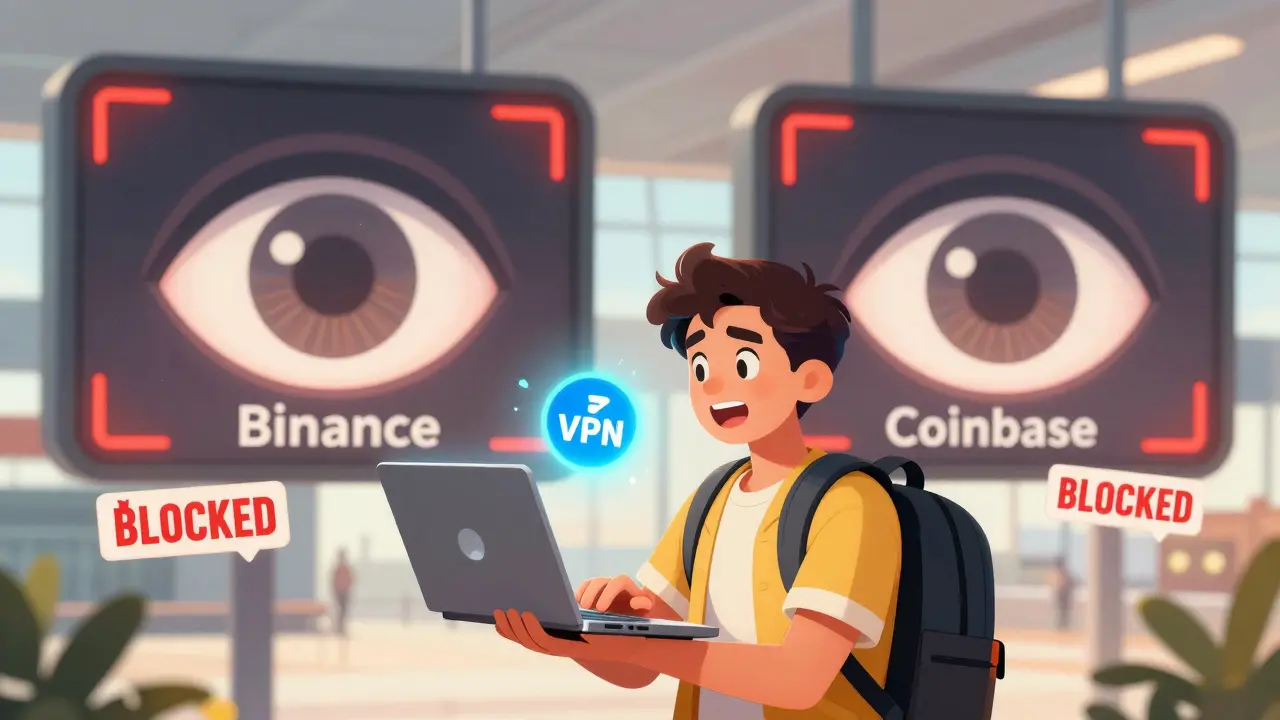
When you try to access your favorite crypto exchange from a different country - maybe you’re traveling, or your local exchange is blocked - you might think a VPN is your best friend. It’s quick, easy, and hides your real location. But here’s the truth: crypto exchanges detect 70-80% of VPN connections. Not all of them. Not every time. But often enough that your account could get locked, your withdrawals frozen, or your login blocked - all without warning.
How Exchanges Know You’re Using a VPN
Crypto exchanges don’t just guess. They use layered systems to catch VPN users. Think of it like a security checkpoint with multiple scanners.- IP Blacklists: Exchanges maintain huge databases of IP addresses linked to known VPN providers. If your IP shows up on one of those lists - boom - flagged.
- Behavioral Tracking: If you log in from Sydney at 8 a.m., then from Berlin at 8:05 a.m., the system sees that as impossible. No human moves that fast. So it flags you.
- DNS and WebRTC Leaks: Even if your VPN is on, your browser might accidentally reveal your real IP through WebRTC or DNS requests. Many exchanges test for this automatically.
- Machine Learning: The biggest exchanges like Binance and Coinbase use AI to analyze patterns: how often you trade, what time you log in, how long you stay logged in, even how fast you type your password. If it doesn’t match your usual behavior, it raises a red flag.
These aren’t theoretical tools. They’re live, active, and improving every month. A 2025 analysis by PureVPN showed that exchanges now cross-check IP addresses with regional banking patterns, device fingerprints, and even mobile carrier data. If you’re using a cheap or free VPN, your chances of getting caught jump to over 85%.
Why Exchanges Block VPNs - It’s Not Just About Control
You might think exchanges are being unfair. But there’s a legal reason behind it.Crypto platforms operating in the U.S., EU, Australia, and other regulated regions must follow strict Know Your Customer (KYC) and Anti-Money Laundering (AML) rules. If you’re trading from a country where crypto is banned - say, Nigeria or Iran - and you use a VPN to bypass that, the exchange could face massive fines. Some have been fined over $100 million for failing to block users from restricted jurisdictions.
So they don’t just block VPNs to be annoying. They block them to survive. That’s why the biggest exchanges - Coinbase, Binance, Kraken - have the most advanced detection systems. Smaller or decentralized exchanges? They often don’t even try. But those are riskier platforms to use anyway.
Not All VPNs Are Created Equal
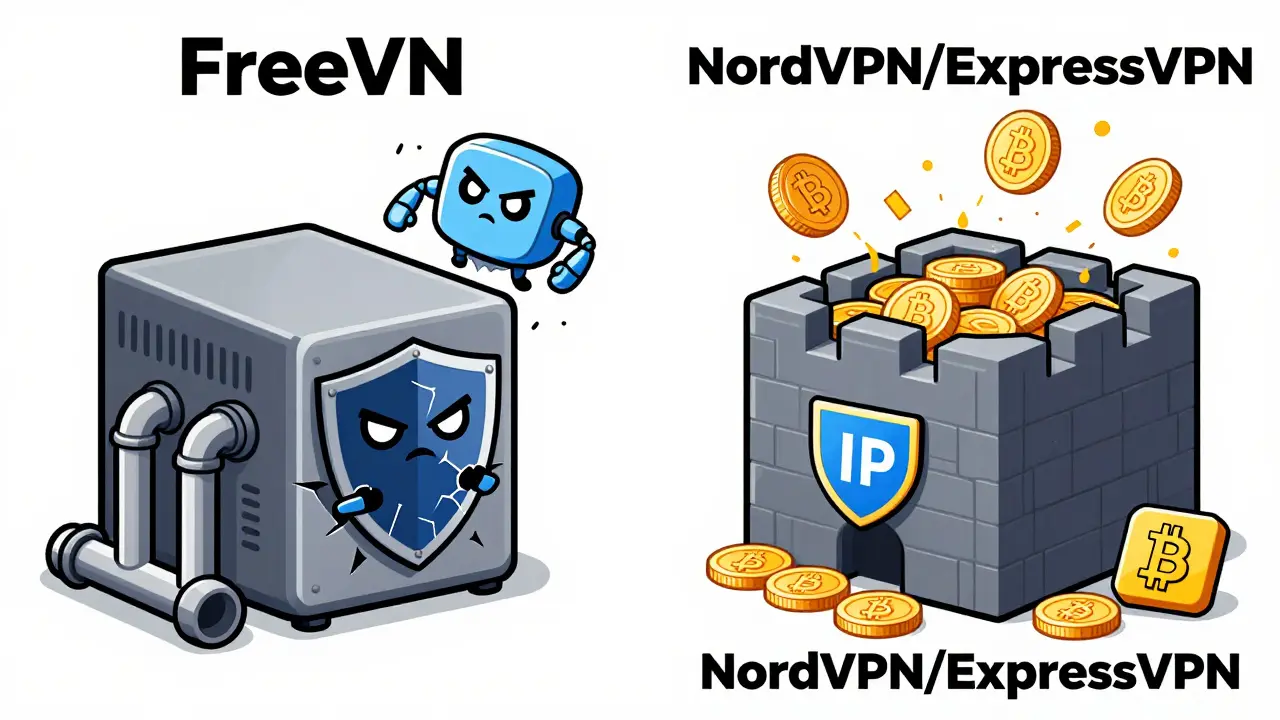
You can’t just grab any VPN and expect to trade safely. Most free or budget services are dead on arrival. They use shared IPs, outdated servers, and are listed in every exchange’s blacklist.But there are two premium services that actually work - and they’re designed for crypto traders:
- NordVPN: Offers dedicated IP addresses (not shared), RAM-only servers in Panama (no data retention laws), and accepts crypto payments via Bitcoin, Ethereum, and Tron. Their servers in 118 countries are optimized to avoid detection. Users report fewer blocks than any other provider.
- ExpressVPN: Based in the British Virgin Islands, with 3,000+ servers across 94 countries. Accepts Bitcoin only. Uses residential IPs (real home internet connections, not data center IPs) which are harder to flag. Their obfuscation tech masks VPN traffic as regular HTTPS traffic.
These services cost $8-$12/month - way more than free options. But if you’re trading serious amounts, that’s cheaper than losing access to your funds for weeks while you appeal a suspension.
What Happens When You Get Caught
It’s not always instant. Sometimes you’ll just notice slower withdrawals. Other times, you’ll get an email: “Suspicious login detected. Verify your identity.”Here’s what usually follows:
- Your withdrawal limit drops from 10 BTC to 0.1 BTC.
- You’re forced to submit extra ID - passport, utility bill, selfie with ID.
- Your account gets temporarily frozen while they review your “activity.”
- If you keep using the same VPN, they may permanently restrict your account.
Some users report being locked out for weeks. Others never get their funds back. Exchanges don’t have to explain why. Their terms of service say they can restrict access for “security reasons.”
What You Can Do - Legally and Safely
If you need to access crypto from a restricted area, here’s what actually works:- Use NordVPN or ExpressVPN: These are the only two with proven success rates above 80% for bypassing detection.
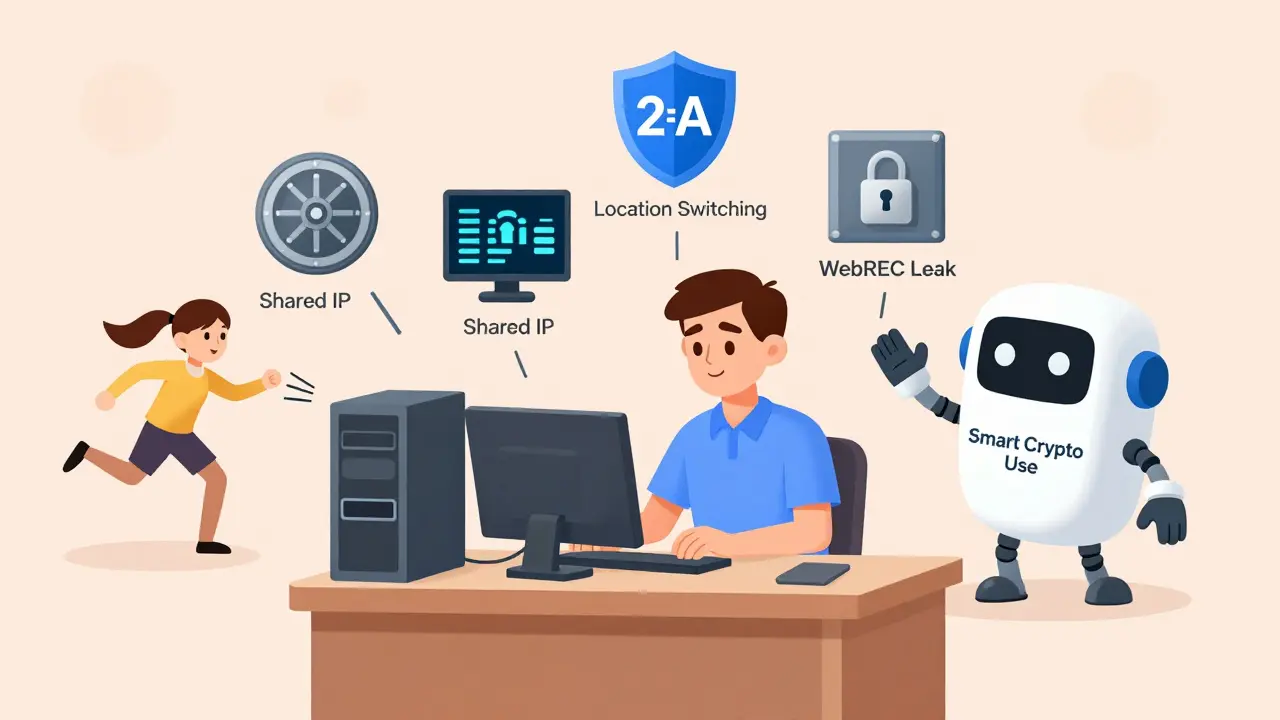
- Don’t switch servers constantly: If you log in from London, stay there. Switching between countries triggers behavioral flags.
- Use a dedicated IP: NordVPN’s dedicated IP option makes your connection look like a regular home user - not a shared VPN.
- Pay with crypto: If you pay for your VPN with Bitcoin, you leave less traceable financial data.
- Enable two-factor authentication: Even if they flag you, 2FA keeps your account safe from hackers.
And here’s the most important thing: your VPN isn’t just for access - it’s for protection. Cybercriminals target crypto traders with phishing sites, fake apps, and malware. A good VPN blocks those attacks. NordVPN even monitors the dark web for leaked wallet passwords. That’s worth paying for.
The Real Risk Isn’t Detection - It’s What Happens After
The 70-80% detection rate sounds scary. But the real danger isn’t getting caught. It’s what comes after.Imagine you’ve got $50,000 in ETH on Binance. You use a free VPN to access it from Thailand. You get flagged. Your account freezes. You submit documents. You wait 14 days. You finally get access - but now your withdrawal limit is $500. You’re stuck.
Or worse: you get banned. No appeal. No refund. No way to move your funds. That’s happened to hundreds of traders in 2024 and 2025.
The best defense? Don’t fight the system. Work with it. Use a premium VPN that’s built for crypto traders. Pay with crypto. Stay in one location. Keep your identity verified. That’s how the smart ones do it.
What About Decentralized Exchanges (DEXs)?
You might think: “Why not just use Uniswap or PancakeSwap? They don’t care where you are.”True. DEXs don’t require KYC. But here’s the catch: you still need a wallet. And if you connect that wallet to a centralized exchange (like Coinbase) to buy your first ETH - you’ve already left a trail. Plus, most DEXs don’t support fiat on-ramps. You still need a centralized exchange to get started.
And if you’re using a DEX from a banned country, your wallet address could still get flagged by Chainalysis or other blockchain analytics firms. That could freeze your funds on any future exchange you try to use.
Final Reality Check
There’s no magic trick. No hidden setting. No “undetected” VPN. The 70-80% detection rate is real because exchanges have to be that accurate to survive legally.If you’re using a free VPN to access crypto - you’re gambling with your funds. If you’re using NordVPN or ExpressVPN with a dedicated IP and stable location - you’re protecting yourself.
The choice isn’t between using a VPN or not. It’s between using a bad one and getting locked out - or using a good one and staying safe.
Can I use a free VPN to access crypto exchanges?
Almost never. Free VPNs use shared IPs that are already on exchange blacklists. Over 85% of free VPN connections are detected and blocked within minutes. They also lack encryption and security features, making your crypto wallet vulnerable to hackers.
Why does my crypto account keep freezing when I use a VPN?
Exchanges flag your account when they detect sudden location changes, unusual login times, or an IP linked to a known VPN provider. Even if you’re not doing anything wrong, the system treats your activity as high-risk. Premium VPNs with dedicated IPs reduce this risk significantly.
Is it legal to use a VPN for crypto trading?
In most countries, yes - as long as you’re not breaking local laws. But exchanges have their own terms of service. Using a VPN may violate those terms, which can lead to account suspension or closure. Legality and platform rules aren’t the same thing.
Which VPNs work best for crypto trading in 2026?
NordVPN and ExpressVPN are the only two with proven success rates above 80%. Both offer dedicated IPs, crypto payments, and servers in countries with no data retention laws. Other providers, even popular ones, are routinely blocked by major exchanges.
Can I avoid detection by switching servers often?
No - it makes detection more likely. Exchanges track login patterns. If you’re in Sydney, then Berlin, then Tokyo within 10 minutes, the system flags you as a bot or fraudster. Stay on one server. Don’t switch unless absolutely necessary.
Do decentralized exchanges (DEXs) block VPNs?
DEXs themselves don’t block VPNs because they don’t require login or KYC. But if you bought crypto on a centralized exchange using a VPN, your wallet address may still be flagged by blockchain analytics firms. That can cause problems later when you try to cash out.
What’s the biggest risk of using a VPN for crypto?
The biggest risk isn’t getting caught - it’s losing access to your funds. Account freezes can last weeks. Some users get permanently banned without recourse. A premium VPN reduces that risk, but the safest move is always to comply with local laws and exchange rules.


Marc Morgan
I used to think free VPNs were fine until my Binance account got locked for 3 weeks. Turned out my 'free' VPN was sharing IPs with a bot farm. Now I pay for ExpressVPN and honestly? Worth every penny. No more headaches.