
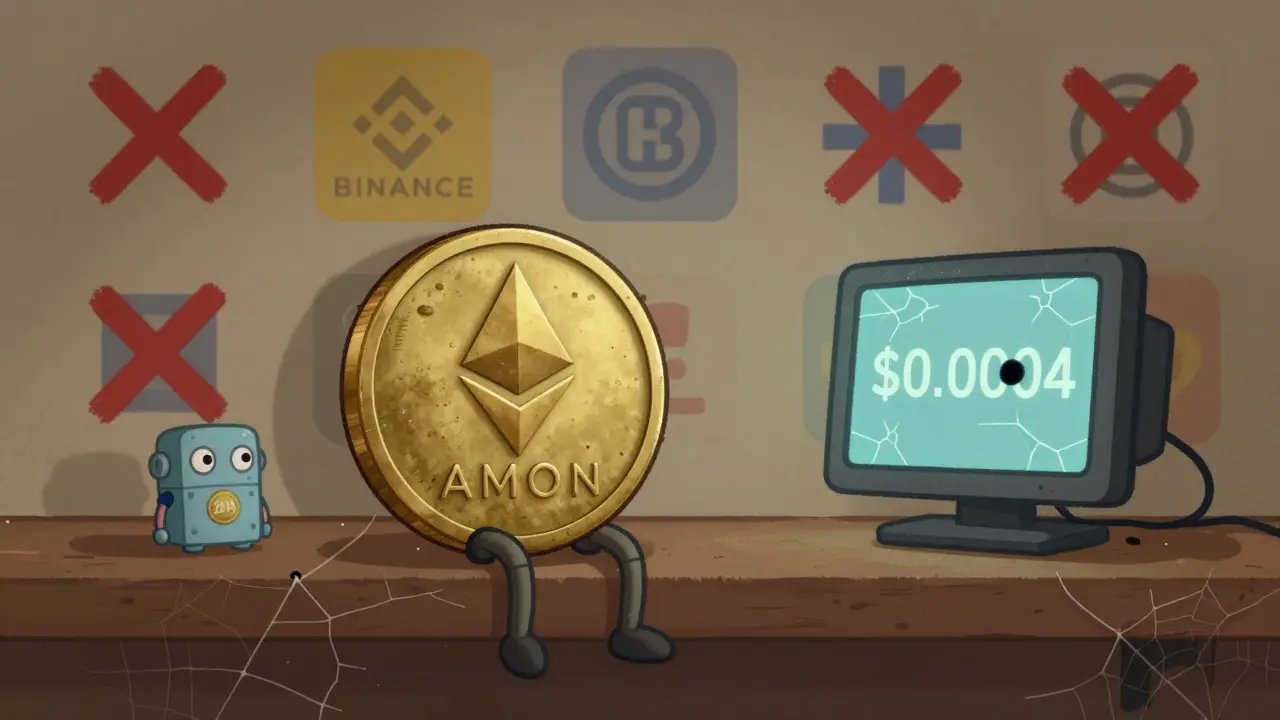
When you hear the name AmonD (AMON), you might think it’s another rising crypto star. But the reality is very different. AmonD is an Ethereum-based token launched in 2019, and seven years later, it’s still stuck in the shadows of the crypto world. There’s no hype, no major exchange listings, and almost no trading volume. If you’re wondering whether AMON is worth your time, here’s the unfiltered truth.
What exactly is AmonD (AMON)?
AmonD is a cryptocurrency built on the Ethereum blockchain. That means it runs on smart contracts, just like most ERC-20 tokens. Its entire supply - 7,176,499,999 AMON tokens - was created at launch and has never changed. Unlike Bitcoin or Ethereum, which have dynamic issuance, AmonD has a fixed supply. No more coins will ever be mined or minted. This makes it a deflationary model by default, but not in the way most people think. With all tokens already in circulation, there’s no inflation, but there’s also no growth mechanism. It’s static.
The project claims to be a direct reward platform, but there’s little public detail on how that works. No whitepaper, no clear use case, and no active development updates on GitHub. The official site, amond.cc, looks basic. The Twitter and Facebook pages haven’t posted in months. That’s not a sign of a thriving ecosystem. It’s a sign of abandonment.
Price and market performance
As of February 2026, AmonD trades around $0.00039 to $0.00059 USD. That’s less than half a cent. In Canadian dollars, it’s about CA$0.00048. Sounds cheap? It is - but not because it’s undervalued. It’s cheap because almost nobody is buying it.
The total market cap? Roughly $3.25 million. For context, that’s less than what a single small-cap stock on the ASX might be worth. The 24-hour trading volume? Sometimes it’s $2. Other times, it’s $4,553. That’s not a market. That’s a whisper.
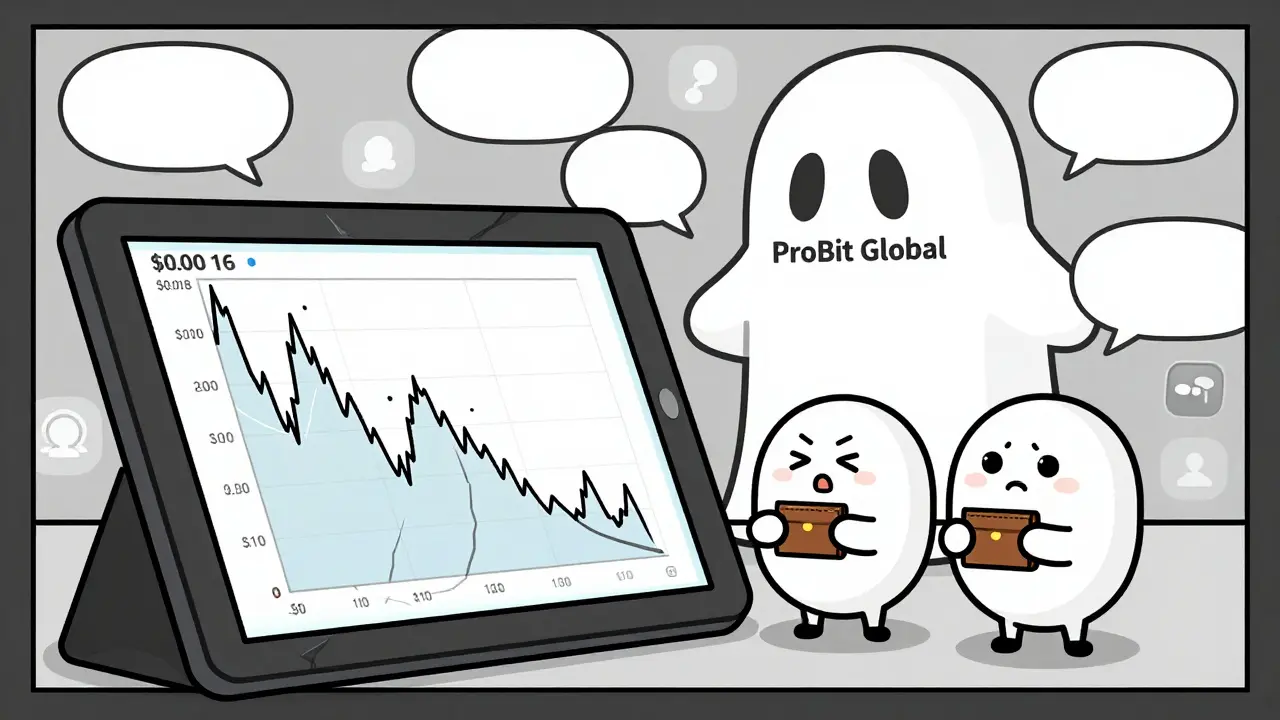
Over the past year, AMON swung between $0.00018 and $0.0016. That’s a 700% range. But here’s the catch: those moves weren’t driven by demand. They were likely pump-and-dump moves on a tiny exchange, with a handful of wallets controlling most of the supply. When volume is this low, even a single large order can swing the price 20% in minutes.
Where can you trade AmonD?
You won’t find AmonD on Binance, Coinbase, or Crypto.com. Not even close. The only exchange where it’s actively traded is ProBit Global. And even there, 98% of all trading happens on the AMON/USDT pair. That’s it. No BTC, no ETH, no USD pairs. Just one token paired with Tether.
The maximum daily volume on ProBit? $2. That’s not a typo. For most of the day, the volume is so low it’s nearly zero. If you tried to sell 100,000 AMON tokens, you’d likely crash the price. There’s no liquidity. No depth. No safety net.
Binance does have educational content on how to buy AMON using their Web3 Wallet - but that’s not the same as listing it. It’s like a car dealership handing out a pamphlet on how to fix a broken scooter you bought off a stranger on eBay.
Technical analysis: What the charts say
Let’s look at the numbers. The RSI(14) is at 17.28 - way below 30. That usually means oversold. But in a market with $2 in daily volume, oversold doesn’t mean “buy.” It just means nobody’s willing to pay more right now.
The Stochastic Oscillator shows 83.33 - overbought. The Stochastic RSI is at 0 - deeply oversold. MACD is flat. ADX is 62.23, which suggests a strong trend - and that trend is down. Williams %R is at -100. CCI is at -933. Ultimate Oscillator is 2.04. Every major indicator, except one, screams sell.
Here’s the kicker: the 200-day moving average is the only one showing a buy signal. All shorter-term MAs - 5, 10, 20, 50, 100 - are pointing down. That’s not a reversal pattern. That’s a death spiral. And with so little trading activity, this isn’t a technical issue. It’s a fundamental one.
Why hasn’t AmonD grown?
It’s been five years since launch. That’s long enough for a project to either gain traction or fade away. AmonD chose the latter. No major partnerships. No product updates. No developer activity on GitHub. No press releases. No community events. No roadmap.
Compare that to tokens that actually built something - like Chainlink or Uniswap. They had clear goals, public development, and real-world use cases. AmonD? It has a website, a token, and a single exchange listing. That’s it.
Why? Maybe the team ran out of money. Maybe they lost interest. Maybe the idea never had legs. Whatever the reason, the market has spoken. No one is buying. No one is using. No one is even talking about it.
Risks of holding or trading AMON
If you’re thinking about buying AmonD, here’s what you’re signing up for:
- Liquidity risk: You might not be able to sell when you want to. Even if the price looks good, there’s no buyer on the other side.
- Exchange risk: ProBit Global isn’t regulated. If it shuts down or gets hacked, your AMON tokens vanish.
- Manipulation risk: With only $2 in daily volume, a few wallets could control the price. A single large sell order could drop the price 50% overnight.
- Zero utility: There’s no app, no wallet integration, no staking, no governance. AMON does nothing.
- Long-term value risk: If no one cares about it now, why would anyone care in five years?
Final verdict: Is AmonD worth it?
No.
AmonD (AMON) is not a scam in the traditional sense - there’s no evidence of fraud or stolen funds. But it’s also not an investment. It’s not a project. It’s a relic. A digital artifact from 2019 that the market has forgotten.
If you’re looking to get into crypto, there are thousands of better options. Projects with real teams, real code, real users, and real trading volume. AmonD has none of that. It’s a ghost coin.
Don’t chase it because it’s cheap. Don’t buy it because you saw it on a price tracker. And don’t hold it hoping it’ll “bounce back.” The market doesn’t bounce back for projects that don’t exist.
If you already own AMON? Consider it a learning experience. If you’re thinking of buying? Walk away. There’s nothing here but noise.


Michael Teague
lol this is just a ghost coin. zero volume, zero purpose. why are people even looking at this? it's like buying a VHS player in 2026.