
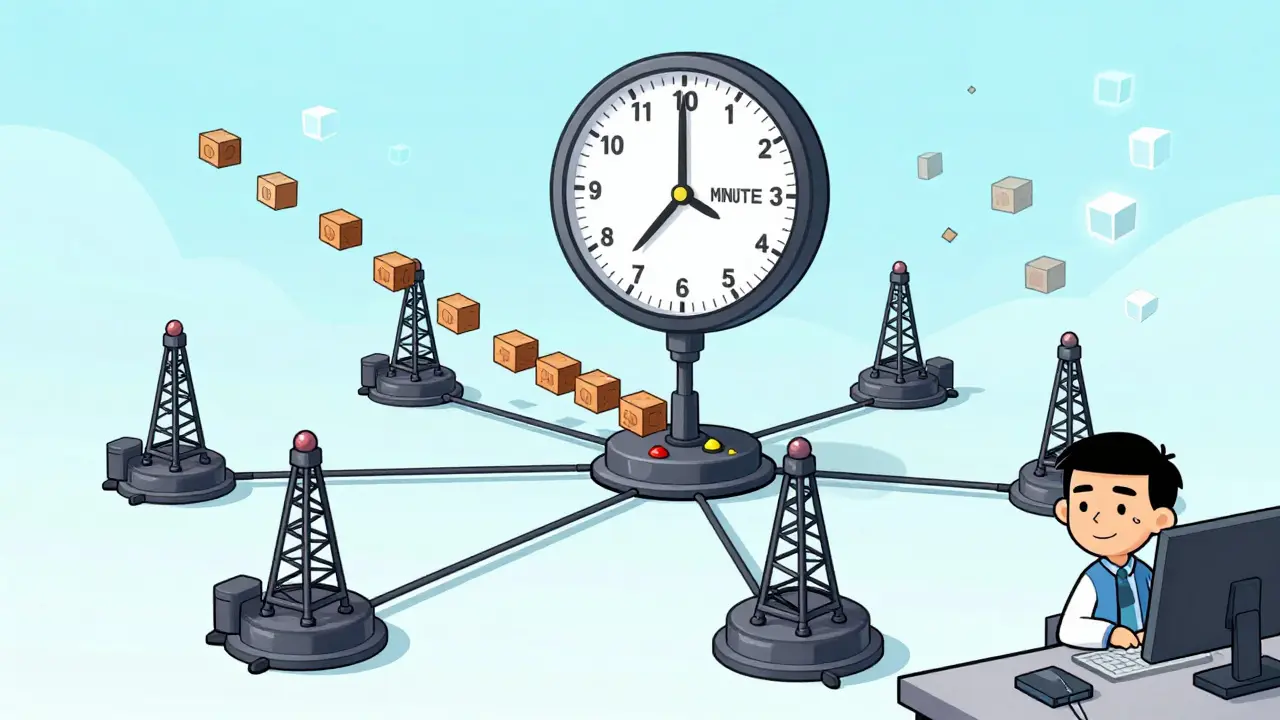
Ever wonder why Bitcoin takes about 10 minutes to confirm a transaction? It’s not arbitrary. That 10-minute window is one of the most deliberate, carefully calculated decisions in all of cryptocurrency history. And it’s still holding strong after 16 years.
When Satoshi Nakamoto built Bitcoin in 2008, they didn’t just pick 10 minutes because it sounded right. They picked it because it was the sweet spot between speed, security, and the real-world limits of early 2000s internet networks. Back then, the average internet latency between major nodes was 200 to 500 milliseconds. If blocks came out too fast - say, every minute - miners in Tokyo would still be waiting for the latest block from New York when the next one was already being mined. That would cause orphaned blocks, where two miners solve a block at nearly the same time, but only one can be added to the chain. The other gets discarded. Too many of those, and the network becomes unstable.
So Satoshi ran the numbers. They found that 10 minutes was long enough for a block to spread across the globe before the next one was found. Not too long to make users wait forever. Not too short to flood the network with duplicates. It was a balance. And it worked.
How the 10-Minute Rule Actually Works
The 10-minute block time isn’t a clock. It’s a target. Bitcoin doesn’t have a timer ticking down. Instead, it’s a statistical average maintained by something called the difficulty adjustment algorithm.
Every 2,016 blocks - which takes about 14 days at 10 minutes per block - Bitcoin checks how long it actually took to mine those blocks. If it took less than 2,016 × 10 minutes (1,209,600 seconds), the network gets harder. If it took longer, it gets easier. The math is simple: new difficulty = old difficulty × (actual time / target time).
Here’s the kicker: because mining is random - like rolling dice - the time between blocks varies wildly. Sometimes a block comes in 2 minutes. Other times, it takes 30. According to data from iyield.com, the longest recorded gap between blocks was over 25 hours. But over time, it averages out to 10 minutes.
This randomness has a weird side effect: if you randomly pick a moment in time, your expected wait time for the next block is 10 minutes - not 5. Why? Because longer intervals are more likely to contain your random moment. Think of it like waiting for a bus that comes every 10 minutes on average, but sometimes comes every 2 minutes and sometimes every 20. You’re more likely to show up during the 20-minute gap. That’s how probability works.
Why Not 5 Minutes? Or 20?
Some people ask: why not make it 5 minutes? Faster confirmations, right? Or 20 minutes? More security?
MIT’s Digital Currency Initiative ran simulations in 2023 to test this. They found that reducing block time to 2 minutes would cause orphan rates to jump from Bitcoin’s current 0.1-0.5% to nearly 9%. That’s a disaster. Every orphaned block means wasted mining power, lost fees, and potential chain reorganizations - where the network temporarily splits and one side gets abandoned. That’s a security risk.
On the flip side, if you doubled the block time to 20 minutes, transactions would take forever. People wouldn’t use it. Exchanges would demand 12 confirmations just to feel safe - that’s 4 hours. No one wants to wait that long to send money.
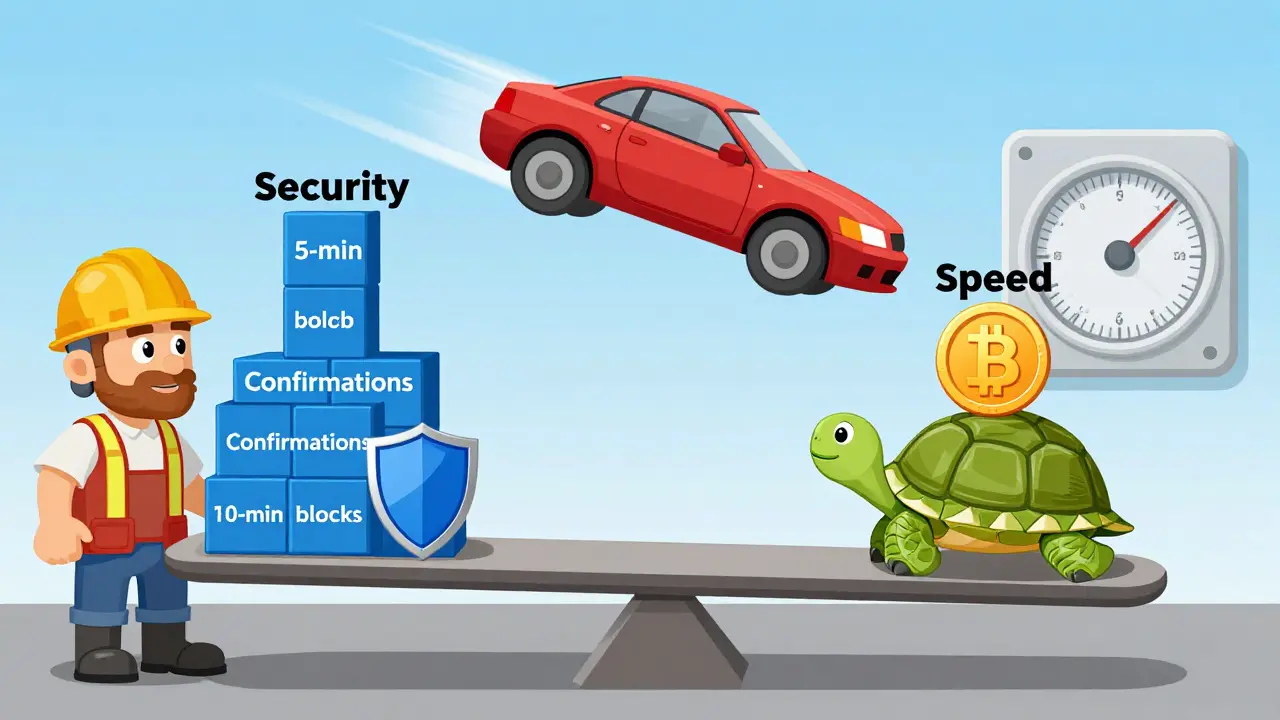
So 10 minutes? It’s the Goldilocks zone. Fast enough to feel usable. Slow enough to stay secure.
Security Through Slowness
This is where Bitcoin gets clever. The longer it takes to confirm a block, the more time other miners have to build on top of it. That’s why Bitcoin transactions are considered final after 6 confirmations - about 60 minutes. Each confirmation adds another layer of proof that the transaction won’t be reversed.
Compare that to Ethereum, which has a 12-second block time. That’s fast, but it’s also fragile. Ethereum sees orphan rates of 3-5%, meaning more than 1 in 20 blocks get discarded. That’s why Ethereum transactions are considered final after just 12-30 seconds. Bitcoin’s slower pace makes it harder to rewrite history. The math says: the deeper the chain, the harder it is to overtake.
And that’s why Bitcoin is called “digital gold.” It’s not built for speed. It’s built to last. To be unchangeable. To be the most secure store of value on the internet.
What About Transaction Fees and Congestion?
Because blocks are limited to about 4 MB (after SegWit), and they only come every 10 minutes, there’s a bottleneck. When demand spikes - like during the BRC-20 craze in early 2024 - transactions pile up. Miners pick the ones with the highest fees first. In April 2021, fees hit $54 per transaction. In quiet periods, they’re under $1.
Users don’t like waiting. Reddit threads are full of complaints: “Paid $35 in fees and still waited 45 minutes.” But others say: “Sent $50,000 with $2.50 in fees. Confirmed in 12 minutes.”
That’s the trade-off. You pay for speed. Or you wait. Bitcoin doesn’t force you. It lets the market decide.
And that’s why Layer 2 solutions like the Lightning Network exist. They handle small, fast payments off-chain. Bitcoin’s base layer? Still 10 minutes. Still secure. Still the anchor.
Why It’s Never Changed
People have tried. Over the years, there have been proposals to shrink the block time. To increase it. To automate it. But Bitcoin’s community has always said no.
Pieter Wuille, one of Bitcoin Core’s lead developers, said it plainly in 2022: changing the block time would require a hard fork. And hard forks need near-unanimous agreement. That’s impossible with Bitcoin’s decentralized, global, opinionated user base.
More importantly, no one has a better idea. The 10-minute block time isn’t just a technical detail. It’s part of Bitcoin’s identity. It’s why miners trust the network. Why exchanges rely on it. Why people treat it like digital gold.
Even Litecoin, which was designed as a “lighter” version of Bitcoin, went with a 2.5-minute block time. And it still hasn’t matched Bitcoin’s security or adoption. That says something.
The Bigger Picture
The 10-minute block time isn’t just about mining. It’s tied to Bitcoin’s entire economic model. The block reward halves every 210,000 blocks. At 10 minutes per block, that’s roughly every 4 years. That’s why we had halvings in 2012, 2016, 2020, and the next one in April 2024. That schedule is baked into the code. Change the block time, and you break the halving. Break the halving, and you break Bitcoin’s scarcity.
It’s not just about security. It’s about predictability. It’s about trust.
Bitcoin doesn’t need to be fast. It needs to be reliable. And for that, 10 minutes is perfect.
Why does Bitcoin’s block time average 10 minutes if blocks are mined randomly?
Bitcoin doesn’t enforce a fixed 10-minute interval. Instead, it adjusts mining difficulty every 2,016 blocks (roughly every 14 days) to keep the average time between blocks at 10 minutes. If blocks are found too quickly, difficulty increases. If too slowly, it decreases. This keeps the long-term average stable, even though individual blocks can take 2 minutes or 20 minutes.
What happens if a block takes longer than 10 minutes to mine?
Nothing breaks. The network just waits. Longer block times are normal and expected. The difficulty adjustment will eventually lower the mining difficulty to compensate, making it easier for miners to find the next block. This keeps the average on track. The longest recorded gap was over 25 hours - and the network still kept going.
Could Bitcoin ever change its block time to 5 minutes?
Technically, yes - but it would require a hard fork and near-unanimous agreement from miners, nodes, and users. In practice, it’s extremely unlikely. The Bitcoin community values stability over speed. Changing the block time would increase orphan rates, reduce security, and risk splitting the network. Most experts agree the current 10-minute target is optimal.
How does block time affect transaction confirmation speed?
Slower block times mean slower confirmations. Bitcoin typically requires 6 confirmations (about 60 minutes) for high-value transactions to be considered final. This is because each additional block adds more proof that the transaction won’t be reversed. Faster blockchains like Ethereum confirm in seconds, but they’re more vulnerable to reorganizations. Bitcoin sacrifices speed for certainty.
Does the 10-minute block time limit Bitcoin’s usefulness as a payment system?
Yes - on the base layer. Bitcoin can only handle about 7 transactions per second, which is far below Visa’s 1,700+ tps. That’s why Layer 2 solutions like the Lightning Network exist. They handle micropayments off-chain, while Bitcoin’s base layer focuses on security and settlement. The 10-minute block time isn’t a flaw - it’s intentional. Bitcoin isn’t meant to replace credit cards. It’s meant to be a secure, decentralized settlement layer.
Final Thought
The 10-minute block time isn’t a bug. It’s the feature. It’s the quiet, unchanging heartbeat of Bitcoin. While other chains race to be faster, Bitcoin stays steady. It doesn’t need to be quick. It just needs to be right. And for 16 years, it has been.


Graham Smith
The 10-minute block time isn't merely a technical parameter-it's a cryptographic equilibrium point derived from first-principles network propagation constraints. Satoshi's design implicitly accounts for the finite speed of light across distributed peer-to-peer topologies, where latency variance between continental nodes necessitates a buffer zone to prevent orphan propagation. This isn't optimization-it's entropy management at scale.
Modern blockchains that optimize for throughput at the expense of finality entropy are fundamentally misaligned with the trust-minimization axiom. Bitcoin's elegance lies in its deliberate inefficiency: by forcing miners to wait, it ensures that reorgs become economically irrational. The 10-minute window isn't a bottleneck-it's a cryptographic moat.
Compare this to PoS chains that rely on finality gadgets and committee voting. Those are centralized trust assumptions dressed in decentralized clothing. Bitcoin's probabilistic finality, grounded in work, is the only consensus mechanism that survives adversarial conditions without appeal to authority. The block time is the heartbeat of that trust model.
And let's not forget: difficulty adjustments are a feedback loop of astonishing robustness. They're not a PID controller, but a self-correcting thermodynamic system. The network doesn't 'know' the target-it converges toward it through emergent behavior. That's why no centralized entity can manipulate it. The math is the law.
Anyone advocating for a 5-minute block time fundamentally misunderstands the tradeoff between liveness and safety. The orphan rate doesn't scale linearly-it scales exponentially with decreasing block intervals. MIT's 9% simulation isn't a worst-case-it's the baseline under current hash rate distribution. We're not talking about efficiency. We're talking about existential risk.
The fact that this has held for 16 years under orders-of-magnitude increases in hash rate is the strongest evidence of Satoshi's genius. It's not a hack. It's a theorem.