

You want to buy shares of Apollo Global Management (NYSE: APO), but the New York Stock Exchange is closed for the weekend. Or maybe you live in a country where buying U.S. stocks is a bureaucratic nightmare. This is exactly why APOon exists.
APOon is a blockchain-based token that represents ownership in Apollo Global Management stock. It isn't a new company. It isn't a meme coin hoping for viral hype. It is a digital receipt proving you hold a slice of one of the world's largest alternative asset managers. Developed by Ondo Finance, this token bridges the gap between traditional Wall Street finance and the 24/7 nature of cryptocurrency markets.
If you are looking at your portfolio and wondering if this niche tokenized asset belongs there, you need to understand how it works, who can actually buy it, and what risks come with holding a security on the blockchain. Let’s break down the mechanics, the costs, and the reality of trading APOon in 2026.
How APOon Actually Works
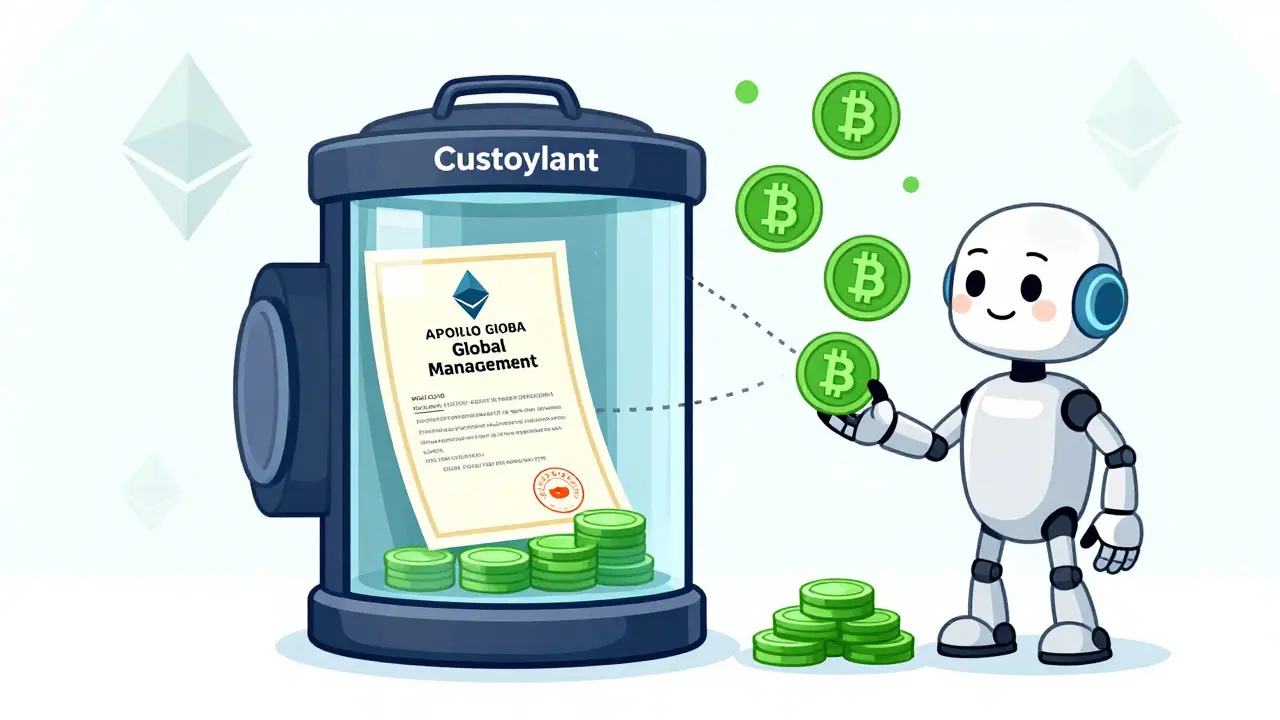
To get APOon, you don’t just click "buy" on any random exchange. You are participating in a process called tokenization. Here is the simple version: Ondo Finance buys actual shares of Apollo Global Management. They lock those shares up with a custodian. Then, they mint ERC-20 tokens on the Ethereum blockchain that represent those shares.
When you hold APOon, you have economic exposure to Apollo. If Apollo’s stock price goes up, your APOon value goes up. If Apollo pays dividends, Ondo reinvests them or distributes them according to their protocol rules. You aren't voting on shareholder meetings, but you are riding the financial wave of the underlying asset.
The technical backbone relies on smart contracts. The primary contract lives on Ethereum at address 0x4d21affd27183b07335935f81a5c26b6a5a15355. There is also a version on BNB Chain. As of late 2025 and early 2026, the total supply hovers around 6,125 tokens. That sounds like a lot until you realize each token tracks the value of a significant portion of the stock, keeping the market cap relatively small compared to giants like Bitcoin or even BlackRock’s tokenized funds.
Who Can Buy APOon? The Regulatory Catch
This is the part that trips up most new investors. APOon is not available to everyone. Because it is a representation of a U.S. equity, it falls under strict securities laws.
Ondo Finance structures APOon under Regulation S of the U.S. Securities Act. What does that mean for you? It means if you are a U.S. person-living in the United States-you generally cannot buy it directly through these retail channels. It is designed for non-U.S. residents. Whether you are in Perth, London, or Singapore, you need to pass identity verification (KYC) to prove you are outside the U.S. jurisdiction.
The legal entity behind the token operates out of the British Virgin Islands, which helps facilitate this global access while staying compliant with SEC oversight. So, before you connect your wallet, check your eligibility. Trying to bypass this with a VPN usually leads to frozen assets later when the platform demands proof of residence.
Price, Liquidity, and Market Reality
Let’s talk numbers. In December 2025, APOon hit an all-time high of $151.23. By mid-2026, prices fluctuate around the $133-$146 range depending on the exchange and the premium over the underlying stock. Why the premium? Sometimes demand for the token exceeds the immediate availability of shares, or traders are betting on short-term volatility that the token captures faster than traditional brokers.
However, liquidity is the elephant in the room. The total market capitalization sits around $800,000 to $900,000. Compare that to BlackRock’s BUIDL fund, which holds hundreds of millions in assets. APOon is a niche product. Daily trading volume often stays below $300 across major platforms like CoinMarketCap and Crypto.com.
| Metric | Value |
|---|---|
| Current Price Range | $133.57 - $146.00 |
| All-Time High | $151.23 (Dec 2025) |
| Market Cap | ~$818,500 - $912,000 |
| Total Supply | 6,125.42 tokens |
| Holders | 64 wallets total |
| Daily Volume | Low ($170 - $270) |
With only 64 total holders and low daily volume, selling a large position can move the price significantly. If you try to sell 10% of the entire supply at once, you might face a steep discount because there simply aren't enough buyers waiting on the other side. This makes APOon better suited for long-term holding rather than day-trading strategies.

Pros and Cons of Holding Tokenized Stocks
Why would anyone choose APOon over just buying Apollo stock on Robinhood or Interactive Brokers? There are clear advantages, but also distinct downsides.
The Advantages:
- 24/5 Trading: Traditional stock markets close at 4 PM EST. Crypto markets never sleep. APOon trades 24 hours a day, five days a week. If big news hits Apollo on a Saturday morning, you can react immediately instead of waiting for Monday.
- Fractional Ownership: You don't need thousands of dollars to buy a full share. You can buy fractions of APOon, making it accessible for smaller portfolios.
- Cross-Border Access: For investors in emerging markets with capital controls, moving money out to buy U.S. stocks is hard. Moving crypto in is often easier.
The Disadvantages:
- Liquidity Risk: As mentioned, low volume means you might struggle to exit quickly without slippage.
- Counterparty Risk: You trust Ondo Finance and their custodians to hold the actual shares. If they fail, your token becomes worthless paper.
- Gas Fees: Transacting on Ethereum can be expensive during peak times. Small transactions might cost more in gas fees than the profit you make.
- Redemption Friction: Getting your actual stock back isn't instant. It takes about 48 hours and involves minimum thresholds (often 50 tokens) and fees around $15.
Future Outlook: Where is APOon Heading?
The broader sector of Real World Assets (RWA) on-chain is exploding. Messari reported the RWA market reached $14.2 billion in Q1 2026. APOon is a tiny speck in this ocean, but it benefits from the tide rising. Institutional players like BlackRock and Franklin Templeton are validating the model, which reduces the stigma around tokenized securities.
Ondo Finance plans to expand APOon to Solana and Polygon networks by Q3 2026. This move aims to cut transaction costs by roughly 63%. If successful, this could unlock more retail interest by making small trades economically viable. Analysts predict a 78% chance of APOon reaching $165 by the end of 2026, driven largely by regulatory clarity from the SEC regarding tokenized equities.
However, keep an eye on concentration risk. Three wallets currently control nearly 67% of the supply. If one of those whales decides to dump, the price could drop sharply regardless of Apollo’s stock performance. Always check the holder distribution before committing significant capital.
Can US citizens buy APOon?
Generally, no. APOon is offered under Regulation S, which exempts offers to non-US persons. US residents typically need to use traditional brokerage accounts to buy Apollo Global Management stock directly.
Is APOon the same as owning Apollo stock?
Economically, yes. Financially, mostly. You get the price movement and dividend benefits, but you do not have direct voting rights in shareholder meetings unless you redeem the tokens for actual shares, which requires a minimum threshold and time.
What happens if Ondo Finance goes bankrupt?
The underlying shares are held by independent custodians, separate from Ondo's operational funds. However, there is still counterparty risk in the smart contract code and the redemption process. Diversification is key; never put all your eggs in one basket.
Which blockchain is APOon on?
Currently, APOon is primarily deployed on Ethereum and BNB Chain. Ondo Finance has announced plans to expand to Solana and Polygon in late 2026 to reduce transaction fees.
How liquid is APOon?
Liquidity is low. With a market cap under $1 million and daily volumes often below $300, large sales can impact the price significantly. It is best treated as a long-term hold rather than a day-trading vehicle.