
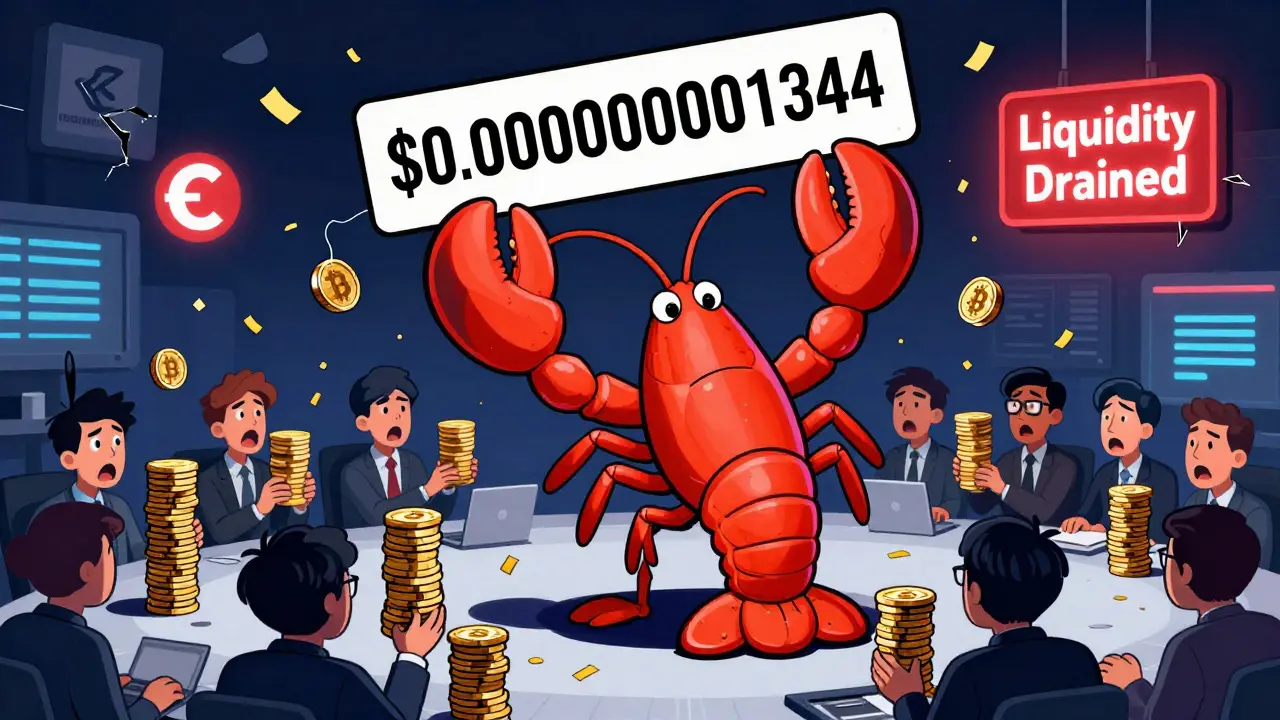
When you hear the name Lobster in crypto, you might think of a fancy seafood delicacy. But in the world of cryptocurrency, Lobster (LOBSTER) is something else entirely - a meme coin so obscure, so low-value, and so illiquid that most people who own it can’t even sell it.
Launched in 2024, LOBSTER isn’t a project with a team, a roadmap, or even a real website. It’s a token with a supply of over 420 trillion coins, priced at around $0.0000000001344 each. That means if you buy 1 trillion LOBSTER tokens, you’re spending about 13 cents. Sounds like a bargain? It’s not. Not even close.
How a Quadrillion Supply Creates the Illusion of Value
One of the first things you’ll notice about Lobster is the insane number of tokens in circulation. CoinGecko says 1 quadrillion. CoinMarketCap says 420.69 trillion. Either way, it’s a number so big it’s meaningless. Why do meme coins do this?
It’s psychological. When Bitcoin trades at $70,000, you can’t afford even one. But if a coin trades at $0.0000000001, suddenly you can own 100 billion of them. That feels like winning - like you’re getting something valuable for almost nothing. But value isn’t about how many coins you hold. It’s about what those coins can actually do.
Lobster offers nothing. No utility. No ecosystem. No team. No updates. Just a ticker symbol and a price chart that bounces between $0.000000000115 and $0.000000000859. Its all-time high came in December 2024. As of November 2025, it’s trading 97.7% below that peak.
No Liquidity. No Way Out.
Liquidity is the lifeblood of any crypto asset. If no one is buying or selling, your coins are digital paper. And Lobster? According to CoinMarketCap, its 24-hour trading volume was $0 as of November 2025. Zero. Not $100. Not $10. $0.
That means if you bought LOBSTER and now want to sell, you’re out of luck. Users on Reddit and CoinMarketCap’s comment section report spending days trying to offload even a small portion of their holdings - and failing. One user posted: "Just lost $50 on LOBSTER - volume is fake, can’t sell anything, classic honeypot scam." It got 147 upvotes.
Even the exchanges that list it are problematic. CoinGecko says it trades on Minswap - a decentralized exchange on Cardano. But CoinSwitch claims it’s on Solana. There’s no official source. No whitepaper. No GitHub repo. No Telegram group with more than 50 people. You’re trading a token that doesn’t even know which blockchain it’s on.
Who’s Behind It? No One.
Every legitimate crypto project has at least a team. Even the worst ones have Twitter accounts. Lobster? No one knows who created it. No names. No bios. No verified social media. That’s not anonymity - that’s invisibility.
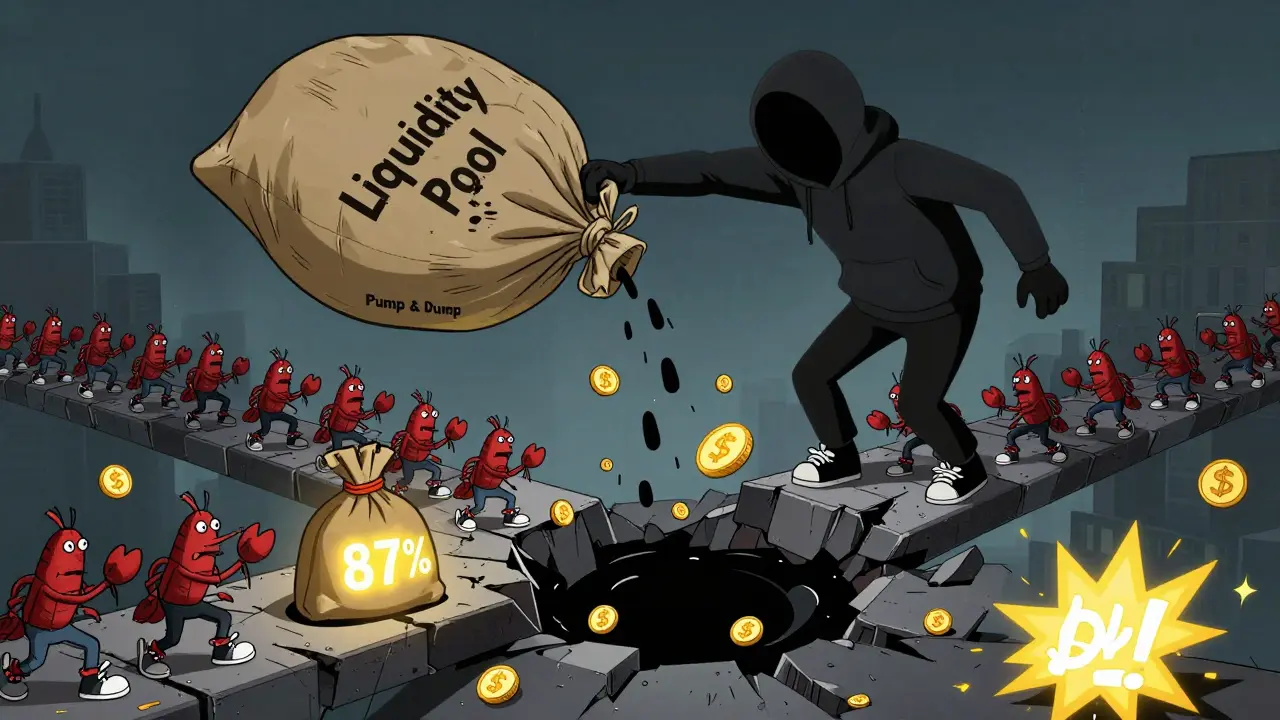
And here’s the scary part: blockchain data shows the top 10 wallet addresses hold 87.3% of all LOBSTER tokens. That’s not decentralized. That’s a pump-and-dump waiting to happen. And guess what? It already did. A Bitcointalk post from November 2025 revealed the creators drained the liquidity pool after the market cap hit $100,000 in October. That’s when the price started crashing.
There’s no community building here. No memes being shared. No influencers pushing it. Just a few dozen wallets holding the entire supply, and thousands of retail investors stuck with coins they can’t trade.
It’s Not a Coin. It’s a Risk.
Lobster doesn’t compete with Dogecoin or Shiba Inu. It competes with the 8,200 other meme coins under $100,000 market cap. And according to Messari’s 2025 report, 95% of these tokens fail within a year.
Compare it to real projects:
- Dogecoin: $13 billion market cap, $1.5 billion daily volume, accepted by merchants, backed by a real community.
- Shiba Inu: $11 billion market cap, Shibarium layer-2 blockchain, active development, millions of holders.
- Lobster: $56,530 market cap, $0 daily volume, no utility, no team, no future.
Even the most volatile meme coins have at least one thing Lobster lacks: a reason to exist beyond speculation. Lobster has no reason. It’s just a number on a chart.
What Happens If You Buy It?
If you’re thinking about buying LOBSTER, here’s what you’re signing up for:
- You’ll spend a few dollars on a token that’s worth less than a penny per trillion.
- You’ll be unable to sell it - not because the price is low, but because no one is buying.
- You’ll get zero customer support. No help desk. No Discord. No email.
- Your wallet might show the tokens, but your transaction will likely fail.
- By next year, it’ll be worth $0. Or worse - it’ll disappear from exchanges entirely.
A 2025 study from the University of California found that tokens with over 1 trillion supply and a market cap under $100,000 have a 98.7% failure rate within six months. Lobster checks every box.

Why Do People Still Buy It?
Because hope is powerful. Because they saw someone else make a "quick buck" on a similar coin. Because they think, "What if this is the next Doge?"
But here’s the truth: Doge didn’t become big because it had a low price. It became big because it had a community, a culture, and real adoption. Lobster has none of that.
The people buying LOBSTER aren’t investors. They’re gamblers. And the house always wins.
Final Verdict: Don’t Touch It
Lobster (LOBSTER) isn’t a cryptocurrency. It’s a cautionary tale.
It’s a reminder that not every token with a funny name is worth your time. Not every low price means low risk. And not every meme coin has a future.
If you’re looking to invest in crypto, stick to projects with transparency, utility, and active development. If you’re just curious - don’t waste your money. The only thing Lobster is good for is being a lesson.
Is Lobster (LOBSTER) a good investment?
No. Lobster has zero utility, no team, no liquidity, and no community. Its market cap is under $60,000, and its 24-hour trading volume is $0. The token is highly likely to become worthless within months. Any money spent on it is almost certainly lost.
Can I sell my Lobster coins?
It’s extremely unlikely. Over 90% of users report being unable to sell their LOBSTER holdings due to zero trading volume. Even if you place a sell order, there are no buyers. The liquidity pool was drained by the creators, making it nearly impossible to exit your position.
Which blockchain is Lobster built on?
There’s no clear answer. CoinGecko lists it on Minswap (Cardano), while CoinSwitch claims it’s on Solana. There’s no official documentation, no whitepaper, and no verified source. This inconsistency is a major red flag - legitimate projects always disclose their blockchain.
Is Lobster a scam?
It fits the profile of a pump-and-dump scam. Anonymous creators launched a token with a quadrillion supply, drove its market cap to $100,000, then pulled all liquidity. No updates, no community, no development. It’s a textbook example of a dead project designed to lure retail investors with false promises of affordability.
How many people own Lobster?
As of November 2025, only 237 unique wallet addresses hold Lobster tokens. The top 10 wallets control over 87% of the supply. This extreme centralization contradicts the core idea of cryptocurrency and suggests the project was never meant to be decentralized.
Does Lobster have a website or official team?
No. There is no official website, no GitHub repository, no Twitter account with verification, and no team members listed anywhere. The project exists only as a token on a few decentralized exchanges with no development activity for over 90 days.


Drago Fila
Hey, I know it’s tempting to chase these low-price coins, but seriously - if you can’t sell it, it’s not an investment, it’s a digital rock. I’ve been there. Lost $30 on a token that vanished from the exchange. Lesson learned: if the project has zero transparency, walk away. No shame in not playing that game.