

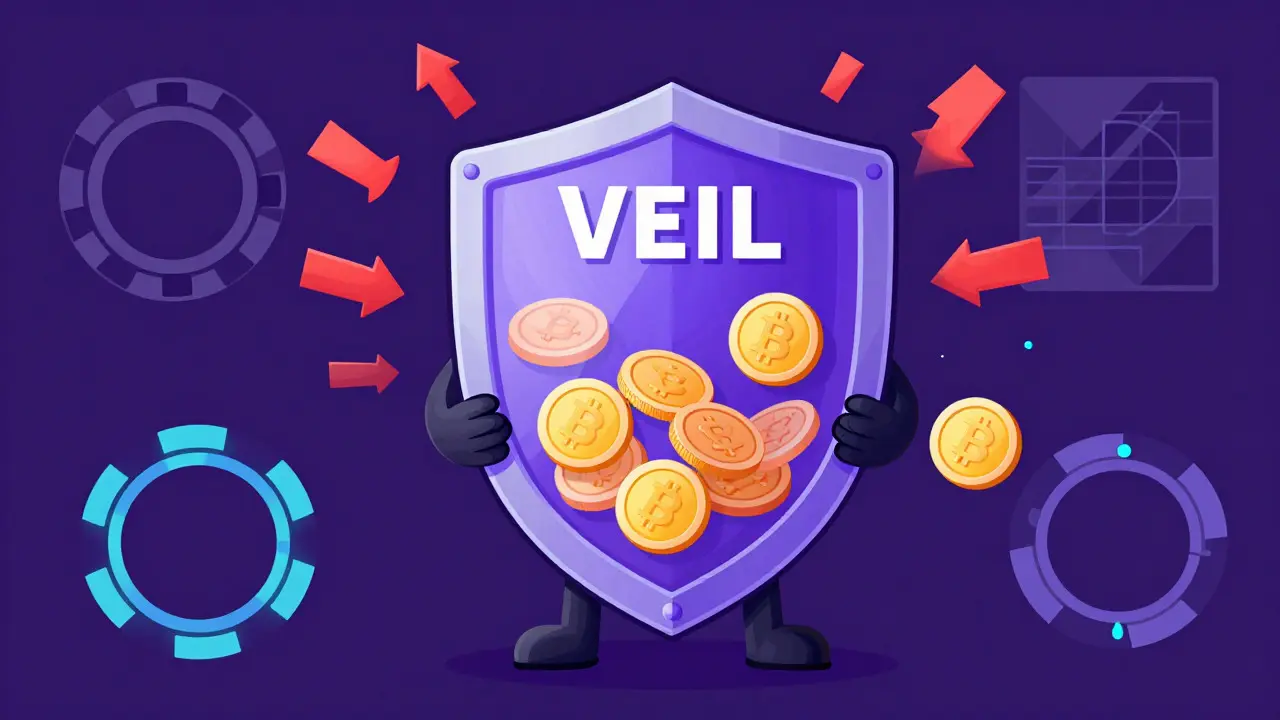
Imagine handing over a $20 bill at a coffee shop. No one tracks where that money came from, and no one knows exactly what you bought. That’s the power of physical cash. But as governments push for digital payments, that privacy is disappearing fast. Enter Veil (VEIL), a cryptocurrency designed to be the encrypted equivalent of physical cash. It’s not just another token hoping for a quick price spike. Veil aims to solve a massive problem: how do we keep our financial data private in a world that increasingly demands transparency?
If you’ve heard whispers about Monero or Zcash but found them confusing or too niche, Veil might catch your eye. It positions itself differently than most privacy coins. Instead of making privacy an optional feature, Veil makes it the default setting. Let’s break down what Veil actually is, how it works, and whether it has a place in your digital wallet.
The Core Mission: Protecting Financial Privacy
At its heart, Veil is built on a simple idea: financial privacy is a human right. The project’s founders noticed that while the world moves toward a cashless society, the $17 trillion annual global economy still reliant on physical cash is under threat. Governments and corporations are increasingly able to track every transaction made through traditional banking apps or even some cryptocurrencies like Bitcoin, where every transfer is visible on a public ledger.
Veil steps in to fill this gap. Launched operationally in 2020 by the Veil Foundation, it’s an open-source project driven by developers worldwide. Unlike many crypto projects that start with an Initial Coin Offering (ICO) and pre-mine tokens for insiders, Veil launched with "no ICO, no premine." This approach was meant to build trust from day one, ensuring a fair distribution among early adopters rather than concentrating wealth in the hands of a few venture capitalists.
The goal isn’t just to hide transactions; it’s to achieve fungibility. In economics, fungibility means one unit of currency is interchangeable with another. A dollar bill is fungible because no one cares if your dollar was previously used to buy bread or pay rent. Most cryptocurrencies aren’t fully fungible because their history can be traced. If a coin was once linked to a dark web market, exchanges might freeze it. Veil aims to make all VEIL coins identical and untraceable, restoring true fungibility to digital money.
How Veil Technology Works Under the Hood
You don’t need to be a cryptographer to use Veil, but understanding its tech helps explain why it’s secure. Veil uses a hybrid consensus mechanism, combining Proof-of-Work (PoW) and Proof-of-Stake (PoS). This dual approach serves two purposes: security and accessibility.
For mining, Veil supports algorithms like RandomX and ProgPoW. These are designed to resist ASIC miners-specialized hardware that centralizes mining power in large farms. By favoring CPUs and GPUs, Veil keeps mining decentralized, allowing everyday users to contribute to network security. On the staking side, holders can lock up their VEIL tokens to earn rewards, similar to interest in a savings account, which helps secure the network without consuming massive amounts of electricity.
But the real magic lies in its privacy features. Veil employs several layers of encryption to ensure your transactions remain confidential:
- Ring Confidential Transactions (RingCT): This technology hides the amount being transferred. Without RingCT, anyone could see that you sent 5 VEIL to someone else. With it, the amount is obscured within a cryptographic ring signature.
- Stealth Addresses: Every time you receive VEIL, a unique, one-time address is generated for that transaction. This prevents outsiders from linking multiple payments to your main wallet address.
- Dandelion Protocol: This obscures the origin of a transaction. When you broadcast a payment, it doesn’t immediately shout out your IP address to the entire network. Instead, it spreads slowly through a small group of nodes before flaring out, making it harder to trace back to you.
All these features work automatically. You don’t have to toggle a "privacy mode" switch. Privacy is compulsory in Veil, ensuring that even novice users benefit from top-tier anonymity.
Veil vs. Other Privacy Coins: What Sets It Apart?
Privacy coins aren’t new. Monero (XMR) and Zcash (ZEC) are the big names here. So why choose Veil? Let’s compare them directly.
| Feature | Veil (VEIL) | Monero (XMR) | Zcash (ZEC) |
|---|---|---|---|
| Privacy Default | Yes (Compulsory) | Yes | No (Optional via zk-SNARKs) |
| Consensus Mechanism | Hybrid PoW/PoS | Proof-of-Work (RandomX) | Proof-of-Work (Equihash) |
| Fungibility Goal | 100% Fungibility | High Fungibility | Variable (depends on shielded pool usage) |
| Future Roadmap | Crypto + Stablecoin + Communication Layer | Cryptocurrency Focus | Cryptocurrency & Enterprise Solutions |
| Token Distribution | No ICO, No Premine | No ICO, No Premine | Pre-mined 20% for Electric Coin Co. |
As you can see, Veil shares DNA with Monero in its commitment to mandatory privacy. However, Veil differentiates itself with its hybrid consensus model, which allows for staking rewards-a feature Monero lacks. Compared to Zcash, Veil offers stronger default privacy since Zcash users often opt for transparent transactions to avoid regulatory scrutiny, inadvertently weakening the privacy set for everyone.
Perhaps the biggest differentiator is Veil’s long-term vision. While Monero stays focused on being a peer-to-peer electronic cash system, Veil has a three-phase roadmap that extends far beyond simple payments.
The Three-Phase Roadmap: More Than Just a Coin
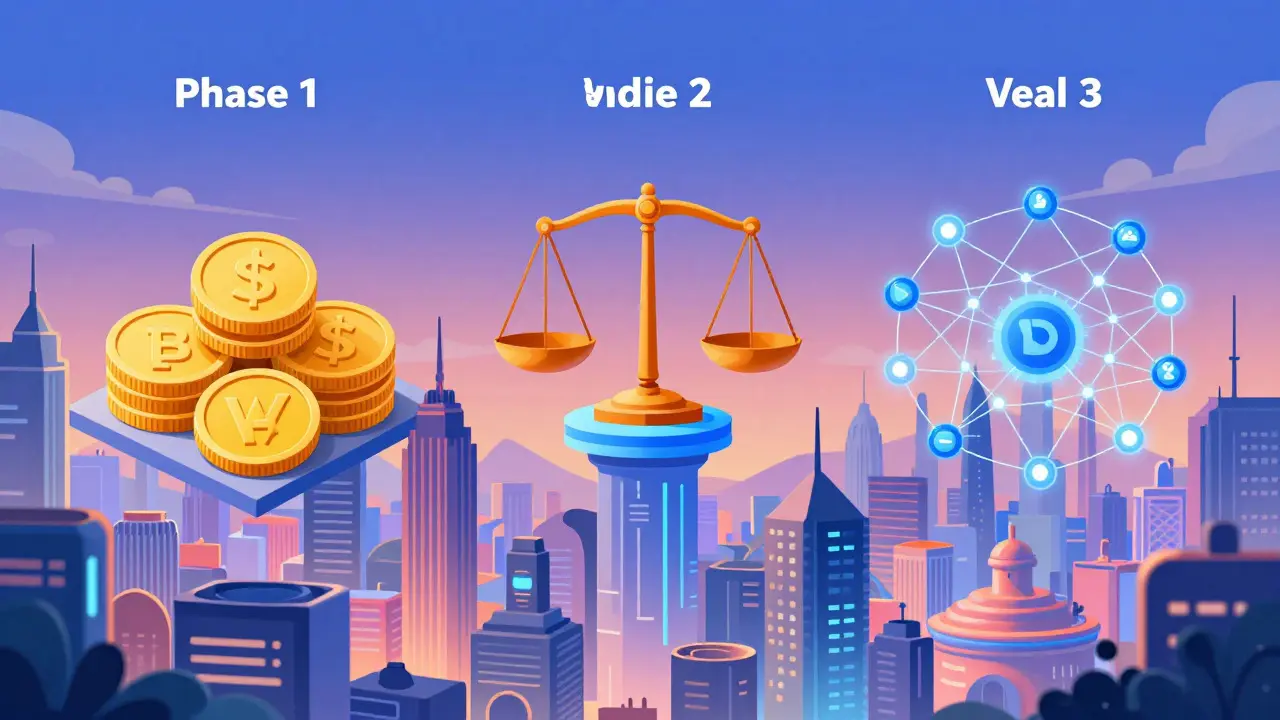
Veil isn’t just trying to be a better Bitcoin or Monero. It aims to build an entire ecosystem for digital privacy. Here’s how they plan to get there:
- Phase 1: $VEIL (Operational since 2020)
This is the core cryptocurrency you know today. It provides surveillance-free transactions using the technologies mentioned above. It’s the foundation of the ecosystem. - Phase 2: $VSD - Decentralized Stablecoin (Research Phase)
Volatility is the biggest hurdle for crypto adoption. To fix this, Veil plans to launch VSD, a stablecoin collateralized exclusively by "prime privacy coins" like Veil, Monero, and Zcash. Think of it like MakerDAO’s DAI, but instead of Ethereum assets backing it, privacy coins do. This would allow merchants to accept a stable value without exposing themselves to price swings, all while maintaining privacy. - Phase 3: Encrypted Interoperability Layer (Research Phase)
This is where things get ambitious. Veil wants to expand privacy beyond finance into communication. This layer aims to provide decentralized privacy for messaging and device interactions, essentially creating a private internet infrastructure that isn’t controlled by Big Tech companies.
This multi-layered approach sets Veil apart. It acknowledges that financial privacy is useless if your communications are monitored. By tackling both, Veil positions itself as a comprehensive privacy solution rather than just a payment method.
Market Reality: Adoption, Risks, and Challenges
While the technology is impressive, let’s talk about the hard truths. Veil is not a household name yet. As of 2026, its market presence is significantly smaller than Monero or even Dash. According to data from CoinGecko and CoinMarketCap, VEIL trades on fewer major exchanges, with platforms like XT.COM being more prominent venues for trading compared to giants like Binance or Coinbase.
This limited exchange availability poses a challenge. Liquidity-the ease with which you can buy or sell without affecting the price-is lower than for top-tier cryptos. This means higher volatility and potentially wider bid-ask spreads when you try to trade.
Regulatory pressure is another elephant in the room. Governments worldwide are cracking down on privacy-enhancing technologies. Exchanges are delisting privacy coins to comply with Anti-Money Laundering (AML) laws. Veil’s website openly acknowledges this tension, stating that in a "let's regulate crypto" environment, staying permissionless and fungible is crucial. However, this very stance makes Veil a target for regulators who view anonymous transactions as a threat to financial oversight.
Despite these challenges, Veil has a dedicated community of privacy advocates. The absence of a premine and the fair launch model have fostered trust among purists who dislike the speculative nature of many modern tokens. The project’s emphasis on user-friendly wallets also helps bridge the gap between complex cryptography and everyday usability.
How to Get Started with Veil
If you’re interested in adding VEIL to your portfolio, here’s what you need to know practically:
1. Choose a Wallet
Veil offers its own official desktop wallet, which is recommended for maximum control and privacy. It supports both mining and staking functions. For mobile users, third-party options may exist, but always verify their security reputation. Never share your seed phrase with anyone.
2. Acquire VEIL
Since Veil isn’t listed on every major exchange, you might need to use a decentralized exchange (DEX) or a specialized platform like XT.COM. Alternatively, you can find P2P markets where users trade directly. Always double-check contract addresses if buying on a DEX to avoid scams.
3. Stake or Mine
If you hold VEIL long-term, consider staking. The process is straightforward: enable staking in your wallet, and you’ll earn rewards passively. If you have spare computing power, you can mine VEIL using RandomX or ProgPoW algorithms, contributing to network security while earning new coins.
Is Veil Right for You?
Veil appeals to a specific type of investor: those who prioritize ideological alignment over short-term hype. If you believe financial privacy is essential and want to support a project that builds infrastructure for a free digital future, Veil is worth exploring. Its hybrid consensus, mandatory privacy, and ambitious roadmap offer a unique value proposition in the crowded crypto space.
However, if you’re looking for quick flips or easy access on mainstream exchanges, Veil might feel cumbersome. Its smaller market cap means higher risk, and regulatory headwinds could impact its availability in certain regions. Do your own research, understand the technology, and decide if the mission resonates with your values.
Is Veil (VEIL) safe to use?
Veil uses robust cryptographic protocols like RingCT and stealth addresses to ensure transaction privacy. Like any cryptocurrency, safety also depends on how you store your coins. Using the official Veil wallet and securing your seed phrase significantly reduces risks. However, always be cautious of phishing sites and unofficial downloads.
Can I mine Veil with my regular computer?
Yes, Veil supports CPU and GPU mining through the RandomX and ProgPoW algorithms. These algorithms are designed to be ASIC-resistant, meaning you don’t need expensive specialized hardware. A modern gaming PC or even a decent laptop can participate in mining, though profitability varies based on electricity costs and network difficulty.
How does Veil differ from Monero?
Both Veil and Monero prioritize mandatory privacy. The key differences lie in consensus mechanisms and roadmap. Veil uses a hybrid Proof-of-Work and Proof-of-Stake model, allowing for staking rewards, whereas Monero relies solely on Proof-of-Work. Additionally, Veil plans to expand into stablecoins ($VSD) and communication privacy, while Monero focuses primarily on peer-to-peer cash.
What is the maximum supply of VEIL?
The maximum supply of VEIL is capped at 300 million tokens. As of recent data, the circulating supply is around 86 million, with a total supply nearing 95 million. This fixed cap helps prevent inflationary pressures common in other cryptocurrencies.
Will Veil face regulatory bans like other privacy coins?
Privacy coins face increasing regulatory scrutiny globally. Some countries have restricted or banned their trading on centralized exchanges. While Veil’s decentralized nature makes it hard to ban entirely, availability on major exchanges may fluctuate depending on local laws. Users should stay informed about regulations in their specific region.
Does Veil have a premine or ICO?
No, Veil launched with no Initial Coin Offering (ICO) and no premine. This means no tokens were reserved for developers or investors before the public launch. The distribution was intended to be fair and decentralized from the start, building trust within the community.
What is $VSD in the Veil ecosystem?
$VSD is Veil’s planned decentralized stablecoin, currently in the research phase. It will be collateralized by a basket of privacy-focused cryptocurrencies like Veil, Monero, and Zcash. The goal is to provide a stable medium of exchange for commerce without sacrificing the privacy benefits of crypto.
How do I stake VEIL to earn rewards?
To stake VEIL, download the official Veil desktop wallet, sync it with the blockchain, and navigate to the staking section. Enable staking, and your wallet will automatically participate in the Proof-of-Stake consensus. Rewards are distributed periodically, similar to interest in a bank account, though rates vary based on network conditions.