
Buying an ASIC Miner is a specialized hardware device designed for mining cryptocurrencies like Bitcoin using the SHA-256 algorithm without running the numbers first is like buying a factory without checking if anyone wants the product. You might end up with expensive metal that eats electricity faster than it prints money. That is exactly why every serious miner, from hobbyists in their garage to industrial farms in Texas, relies on an ASIC Miner Profitability Calculator is a digital tool that estimates potential earnings and return on investment by analyzing hash rate, power consumption, electricity costs, and network difficulty.
In 2026, the math has gotten harder. The April 2024 halving cut block rewards to 3.125 Bitcoin, squeezing margins. Network difficulty keeps climbing as more efficient machines come online. If you are looking at buying new hardware or optimizing an existing rig, you need more than a guess. You need precise data. This guide breaks down how these calculators work, which inputs actually matter, and how to spot the traps that lead to bad investments.
Why Your Gut Feeling Will Cost You Money
You see a coin price spike on Twitter. You think, "Mining must be profitable right now." It feels intuitive. But intuition ignores the two biggest killers of mining profit: Network Difficulty is a metric that adjusts approximately every two weeks to ensure blocks are found every 10 minutes regardless of total network hash rate and your local Electricity Rate is the cost per kilowatt-hour (kWh) charged by your utility provider, often varying by time of day and season.
Dr. Alex de Vries, founder of Digiconomist, noted in May 2024 that most basic calculators overestimate profits by 20-30%. Why? Because they assume static conditions. They don't account for hardware degradation or the fact that difficulty usually rises after a price spike as new miners rush in. A proper calculator doesn't just show you today's profit; it projects your break-even point based on realistic trends. Without this, you might buy a machine that takes four years to pay back itself, only for its efficiency to become obsolete in eighteen months.
The Critical Inputs: What Data You Must Gather
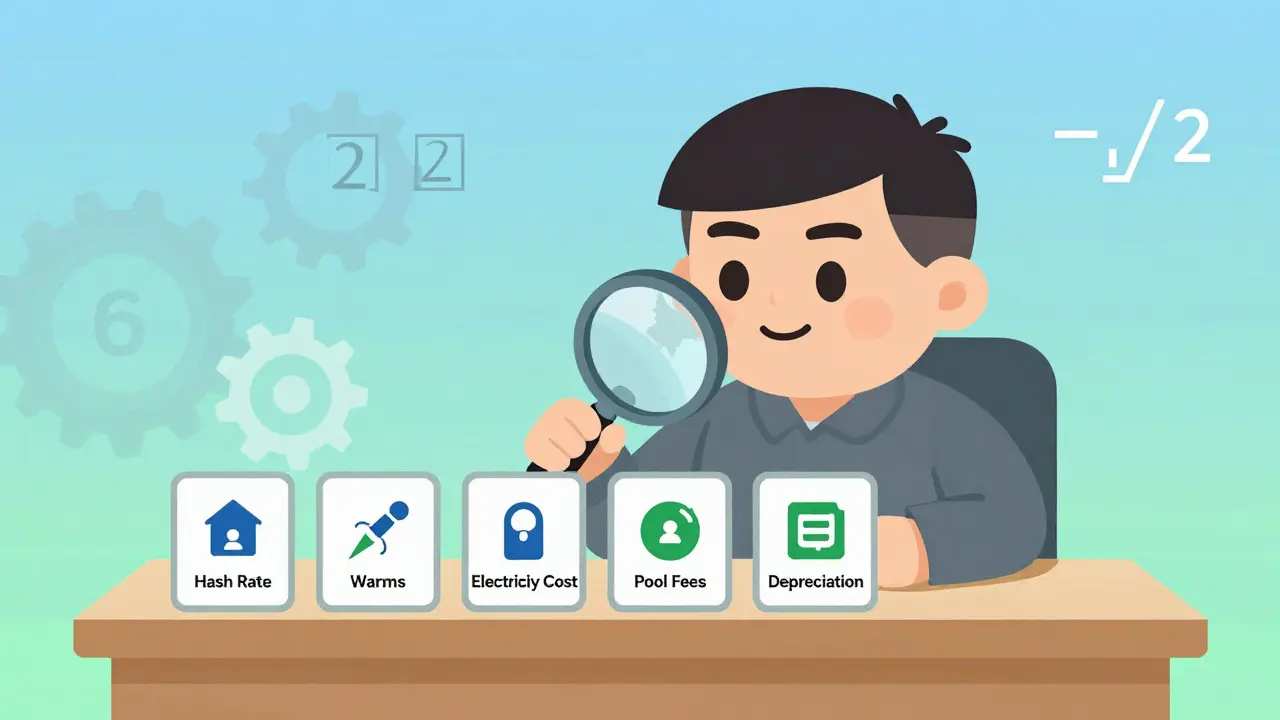
To get an accurate number, you cannot use averages. You need your specific reality. Here are the five non-negotiable inputs you must feed into any reliable ASIC Miner Profitability Calculator:
- Hash Rate: Measured in Terahashes per second (TH/s). For example, the Antminer S19 Pro delivers 110 TH/s. Newer models like the S21 series push higher, but check the actual benchmark, not just the marketing spec.
- Power Consumption: Measured in Watts. An S19 Pro pulls about 3,250W. This is your baseline energy draw before accounting for cooling inefficiencies.
- Electricity Cost ($/kWh): This is the dealbreaker. In the U.S., the average is around $0.138/kWh (EIA, May 2024), but profitable miners often secure rates below $0.05/kWh through renewable contracts or industrial agreements. If you are paying residential rates above $0.10, your margin is razor-thin.
- Pool Fees: Most miners join pools to smooth out income. Expect to pay 1% to 3% in fees. NiceHash and other platforms list these clearly, but always double-check if there are hidden withdrawal fees.
- Hardware Depreciation: ASICs lose value. A machine bought for $3,000 might be worth $1,500 in two years. Advanced calculators factor this loss into your net ROI.
If you miss even one of these, your projection is fiction. Specifically, ignoring cooling overhead can skew results. Add 10-15% to your power consumption estimate to account for fans and air conditioning needed to keep the chips from melting.
Comparing Top Calculators: Which One Fits Your Needs?
Not all calculators are created equal. Some update once a day; others refresh every minute. Some focus on Bitcoin only; others cover 150+ coins. Choosing the wrong tool can lead to missed opportunities or bad buys. Here is how the major players stack up in mid-2026.
| Platform | Update Frequency | Best For | Key Limitation |
|---|---|---|---|
| WhatToMine | 5-10 minutes | Cross-crypto comparison (150+ coins) | Slower updates can miss short-term spikes |
| ASICMinerValue | Every 60 seconds | Real-time Bitcoin mining & hardware pricing | Focused primarily on BTC ecosystem |
| Mining Now | 1-minute real-time | Pure Bitcoin tracking & ML forecasts | Limited support for altcoins |
| EcoHash Cloud | 30 minutes | Green mining & carbon offset metrics | Less granular financial breakdown |
| BlockForge | Real-time API | Enterprise farms (>1 PH/s capacity) | Requires high minimum hash rate |
If you are a solo miner testing the waters, WhatToMine remains the industry standard for breadth. However, if you are strictly mining Bitcoin and want the most current data, ASICMinerValue offers live income estimates updated every minute. For those concerned with regulatory compliance and environmental impact, especially in the EU under MiCA regulations, EcoHash Cloud provides unique carbon savings metrics alongside profit forecasts.
Hidden Costs That Kill Margins
Most beginners look at the "Daily Profit" line and smile. Then they receive their first electric bill and cry. The gap between projected and actual profit usually comes from three hidden sources:
- Transformer Efficiency Loss: Power conversion isn't perfect. ASICMinerValue's July 2024 update highlighted a 5-8% energy loss in power conversion stages. If your calculator doesn't subtract this, you are overestimating your effective hash rate.
- Difficulty Adjustments: Bitcoin adjusts difficulty every 2,016 blocks (roughly two weeks). Post-halving, difficulty has been rising steadily. Mining PoolStats reported a 14.2% monthly increase in difficulty in early 2024. A calculator that uses last week's difficulty will be wildly optimistic next month.
- Hardware Degradation: ASICs run hot. Over time, components fail or throttle. Dr. Garrick Hileman’s research showed that calculators factoring in 3nm chip wear-and-tear are 12.7% more accurate. Assume your machine will drop 1-2% in efficiency every six months.
Always add a buffer. If a calculator says you make $5/day, plan for $4. If it says you break even in 12 months, expect 15. This conservative approach saves you from stranded assets-hardware that becomes worthless because it couldn't compete with newer, cheaper energy costs.
How to Use a Calculator Like a Pro
Using a calculator is simple, but using it *well* requires strategy. Follow this workflow to maximize accuracy:
- Gather Exact Specs: Don't guess your wattage. Check the label on your power supply unit (PSU) and your miner's spec sheet. Input the exact TH/s and Watts.
- Input Real Electricity Rates: Log into your utility provider's portal. Find your off-peak and on-peak rates. If you have a tiered system, use the highest likely tier to be safe.
- Adjust for Cooling: Manually increase your power consumption input by 15% if you are in a warm climate or lack immersion cooling.
- Check Multiple Sources: Run your numbers on both WhatToMine and ASICMinerValue. Average the results. If they differ by more than 10%, investigate why (usually due to different difficulty projections).
- Monitor Daily: Set aside 5 minutes each morning to check your dashboard. Prices and difficulty change daily. What was profitable yesterday might be marginal today.
Pro Tip: During halving events or major market volatility, switch to manual difficulty inputs if the calculator allows it. Automated projections often lag behind sudden network shifts.
Future-Proofing Your Mining Operation
The landscape is shifting. By late 2026, we expect 90% of calculators to integrate environmental impact metrics due to pressure from regulators in the EU and California. Additionally, AI-driven difficulty forecasting, like Mining Now's Q3 2024 release, aims to cut estimation errors by 35%. These tools are evolving from simple math engines into comprehensive management platforms.
For individual miners, the key takeaway is flexibility. Don't lock yourself into long-term contracts based on a single calculation. Keep your options open. Consider hosting services if your local electricity is too high. Or explore immersion cooling to reduce maintenance and heat-related losses. The goal isn't just to mine; it's to mine sustainably and profitably in a competitive global market.
Is Bitcoin mining still profitable in 2026?
Profitability depends entirely on your electricity cost and hardware efficiency. With block rewards at 3.125 BTC post-halving, miners need electricity rates below $0.08/kWh to remain consistently profitable with modern ASICs like the Antminer S21 series. Those paying residential rates above $0.12/kWh will likely operate at a loss unless Bitcoin prices surge significantly.
Which ASIC miner profitability calculator is the most accurate?
ASICMinerValue and Mining Now are considered the most accurate for real-time Bitcoin mining due to their minute-by-minute data updates. WhatToMine is excellent for comparing multiple cryptocurrencies but updates less frequently. Experts recommend averaging results from at least two calculators to account for differing difficulty prediction algorithms.
How does network difficulty affect my mining profits?
Network difficulty adjusts every two weeks to maintain a 10-minute block time. As more hash power joins the network, difficulty increases, meaning you earn a smaller fraction of the block reward. A 10% rise in difficulty directly reduces your revenue by roughly 10%, assuming your hash rate stays constant. Always factor in historical difficulty trends when calculating ROI.
Should I include cooling costs in my profitability calculation?
Yes, absolutely. Cooling can account for 10-15% of your total energy consumption. If you ignore this, your projected profits will be inflated. For accurate results, add 15% to your miner's stated power consumption before entering it into the calculator, or manually input the separate kWh usage of your HVAC systems dedicated to the mining space.
What is the typical payback period for an ASIC miner in 2026?
With current hardware prices and electricity costs, the payback period typically ranges from 12 to 24 months for efficient setups with low energy rates. For miners with higher electricity costs, the payback period can extend beyond 3 years, making the investment risky due to hardware obsolescence. Always aim for a payback period under 18 months to mitigate risk.


Nick Rice
Look, I get the hype around these new S21s, but let's keep it real for a second. Most people ignore the cooling overhead until their electric bill hits them like a truck. You need to factor in that extra 15% for AC or immersion setups, otherwise you are just burning cash. It is not rocket science, but folks love to pretend it is.