
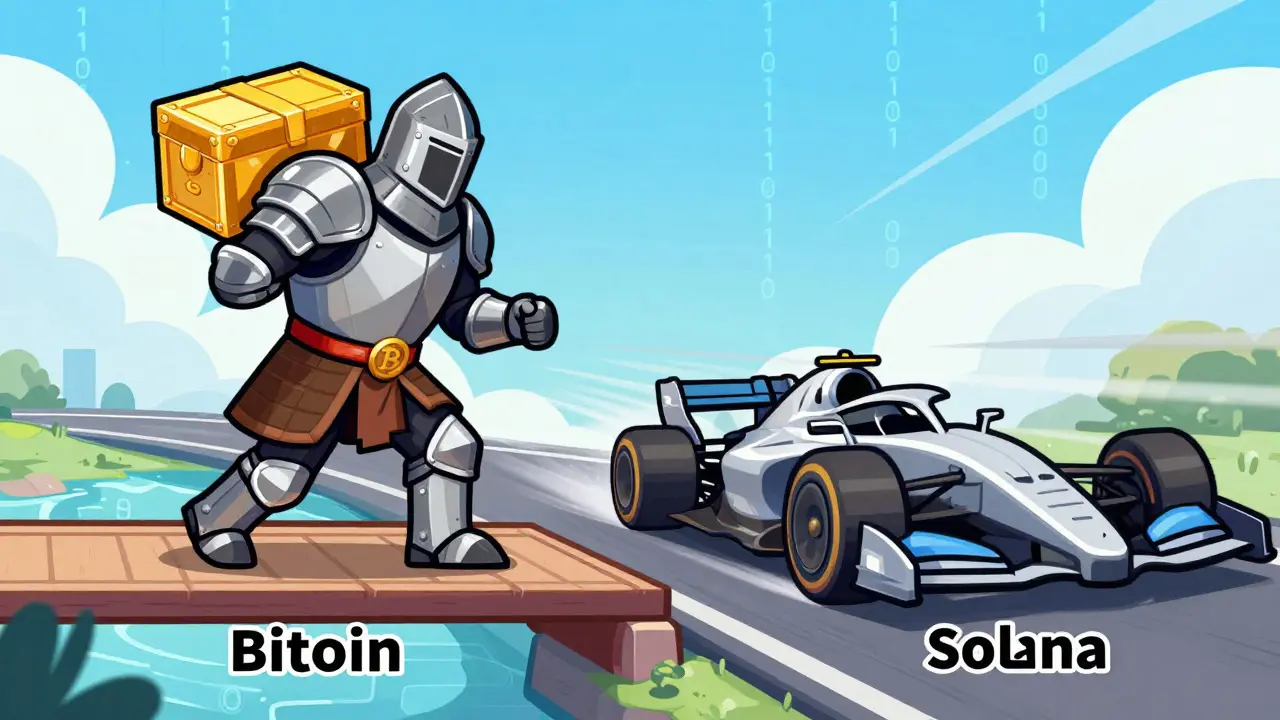
Imagine you are buying a coffee. You tap your phone, the machine beeps, and you walk away with your drink in under three seconds. Now imagine trying to buy that same coffee using Bitcoin, which takes roughly 10 minutes just to produce one block, and often requires waiting an hour for full settlement. For a cup of joe, Bitcoin is painfully slow. But if you were sending $5 million to a bank across the ocean, would you rather have it settle in two seconds with a risk of reversal, or wait an hour to be absolutely sure it cannot be taken back?
This is the core dilemma of blockchain technology: there is no single "best" speed. Every protocol makes a calculated bet on how fast transactions should happen versus how secure they need to be. This balance is defined by block time, the interval between consecutive blocks added to the ledger. Understanding this trade-off is crucial for developers building applications and investors choosing networks. As of mid-2026, the industry has moved past the idea that "faster is always better." Instead, we see a diversified ecosystem where different chains optimize their block times for specific jobs.
The Physics of Block Time: Why Speed Isn't Free
To understand why block time matters, you first need to grasp what actually happens when a block is created. In simple terms, miners or validators solve a puzzle or reach consensus to bundle transactions into a block. Once solved, this block must be broadcast to every other node in the network so everyone can update their copy of the ledger.
Here lies the bottleneck: information travels at the speed of light, but it still takes time to cross oceans. If a validator in New York finds a block and broadcasts it, it might take 2 to 4 seconds to reach a node in Tokyo. During those few seconds, another validator in London might start working on a competing block because they haven't seen the New York block yet. When both blocks are eventually revealed, the network must choose one, and the other becomes "stale" or "orphaned."
This phenomenon creates a direct conflict. Shorter block times mean faster confirmations for users, but they also increase the rate of stale blocks. A high stale block rate reduces the effective security of the network because it gives attackers more opportunities to reorganize the chain. Academic research from 2023 and 2024 formalizes this as a three-way tension among double-spend security, user-facing latency, and throughput. Essentially, if you want instant finality, you either sacrifice decentralization (by requiring fewer, faster nodes) or you accept lower security against attacks.
Bitcoin: The Fortress of Slow Settlement
Bitcoin chose a target block time of 600 seconds (10 minutes). This was not an accident; it was a deliberate design choice made by Satoshi Nakamoto in 2009. At the time, global internet infrastructure was slower, and the goal was to maximize security and censorship resistance. By spacing blocks 10 minutes apart, Bitcoin ensures that most blocks propagate fully across the global network before the next one is found. This keeps the orphan rate low-typically below 1%.
For a retail merchant, 10 minutes feels like an eternity. However, Bitcoin’s model is optimized for high-value store-of-value transfers, not buying groceries. The standard practice for large transactions is to wait for six confirmations, which equals about 60 minutes. This provides a probabilistic security level so high that reversing the transaction would require controlling more than 50% of the entire network’s hash power-a feat considered economically unfeasible.
Does this mean Bitcoin is obsolete for payments? Not necessarily. Many small-value transactions are accepted after zero or one confirmation (0-10 minutes), accepting a tiny sliver of fraud risk in exchange for speed. Additionally, Layer-2 solutions like the Lightning Network sit on top of Bitcoin, handling micro-transactions instantly while settling disputes on the slow, secure base layer. Bitcoin proves that for certain use cases-specifically institutional custody and long-term savings-security trumps speed every time.

Ethereum: The Middle Ground for Smart Contracts
Ethereum operates with a block time of approximately 12 seconds. Before its transition to Proof of Stake in September 2022, Ethereum experimented with various block times, eventually settling on this range to balance developer experience with network stability. Vitalik Buterin, Ethereum’s co-founder, argued early on that block times under a few seconds would cause excessive fork rates on a globally distributed network, while times over a minute would frustrate users interacting with decentralized applications (dApps).
The 12-second slot time allows for a reasonable user experience in DeFi. When you swap tokens on Uniswap, you don’t want to wait 10 minutes to see if the trade executed. Twelve seconds is short enough to feel responsive but long enough to allow thousands of validators to stay synchronized without needing supercomputer-grade hardware. After the Merge, Ethereum introduced Casper FFG, a mechanism that adds economic finality on top of the probabilistic chain. While a block appears in 12 seconds, true irreversibility takes a few minutes, offering a compromise suitable for complex financial contracts.
Solana and High-Frequency Chains: Chasing Milliseconds
On the other end of the spectrum sits Solana, which targets a slot time of 400 milliseconds. To achieve this, Solana uses a unique mechanism called Proof of History (PoH). PoH acts as a cryptographic clock, allowing validators to order events without waiting for network-wide communication at each step. This decouples the ordering of transactions from the consensus process, enabling massive throughput.
In practice, however, "slot time" is not the same as "finality." While a new block is produced every 0.4 seconds, users typically wait 2 to 5 seconds for a transaction to reach a "finalized" state where it is highly unlikely to revert. This speed is critical for use cases like high-frequency trading, gaming, and NFT minting, where latency directly impacts utility. If a game character moves based on a blockchain transaction, a 10-minute delay breaks immersion completely.
Other chains like Avalanche and Algorand target similar speeds, with finality ranging from 1 to 4 seconds. These networks often rely on Byzantine Fault Tolerance (BFT) consensus models rather than Nakamoto-style longest-chain rules, allowing them to achieve deterministic finality much faster. The trade-off? Higher hardware requirements for validators. Running a Solana node requires significantly more RAM and bandwidth than running a Bitcoin node, which inevitably leads to some degree of centralization among professional operators.
| Network | Block/Slot Time | Effective Finality | Primary Use Case | Consensus Model |
|---|---|---|---|---|
| Bitcoin | 600 seconds (10 min) | 30-60 minutes | Store of Value, Institutional Settlement | Proof of Work |
| Ethereum | ~12 seconds | ~10 minutes (economic) | DeFi, Smart Contracts, Rollups | Proof of Stake |
| Solana | 400 milliseconds | 2-5 seconds | High-Frequency Trading, Gaming | Proof of History + PoS |
| Avalanche | 1-2 seconds | 1-2 seconds | Enterprise, Fast Payments | Avalanche Consensus (BFT) |
| Algorand | ~3.3 seconds | ~3.3 seconds | Retail Payments, CBDCs | Pure Proof of Stake (BFT) |
Choosing the Right Block Time for Your Application
If you are building a dApp or integrating blockchain into a business process, you shouldn't just pick the fastest chain available. You need to map your use case to the appropriate security-latency profile. Here is a practical decision framework:
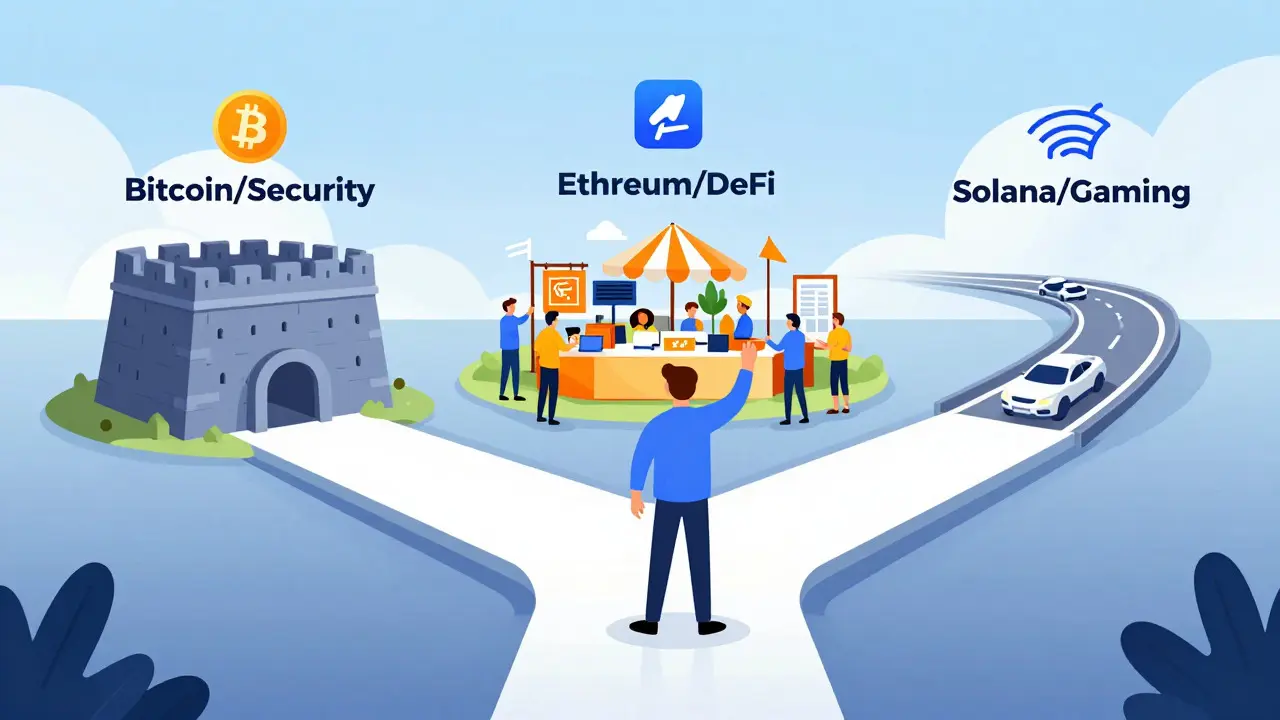
- High-Value Asset Transfer: If you are moving significant capital (e.g., >$10,000), prioritize security. Use Bitcoin or Ethereum mainnet. Accept the longer wait time as insurance against fraud. The cost of a reversed transaction far outweighs the inconvenience of waiting.
- Retail Payments & Point-of-Sale: For everyday purchases, latency is king. Users expect near-instant feedback, similar to Visa or Mastercard (which average ~2.4 seconds authorization). Chains like Solana, Avalanche, or Algorand are ideal here. Alternatively, use Bitcoin/Ethereum with Layer-2 rollups that provide instant UX while settling securely on the base layer.
- Gaming & Social Interaction: These applications require sub-second responsiveness. A lag of even 5 seconds can ruin user engagement. Solana or specialized gaming chains with BFT consensus are necessary. Security is secondary to performance in these contexts, as individual transactions are low-value.
- Decentralized Finance (DeFi): Traders need speed to execute arbitrage or swaps, but they also need finality to avoid front-running attacks. Ethereum’s 12-second blocks offer a middle ground, though many DeFi protocols now migrate to Layer-2s (like Arbitrum or Optimism) to get faster confirmations while inheriting Ethereum’s security.
The Future: Heterogeneous Optimization
As we move through 2026, the trend is clear: there will be no single blockchain to rule them all. Instead, we are seeing a heterogeneous ecosystem. Base layers like Bitcoin and Ethereum continue to serve as secure settlement layers, prioritizing decentralization and robustness. Meanwhile, application-specific chains and Layer-2 solutions optimize for speed, utilizing shorter block times and advanced consensus mechanisms to handle high-throughput demands.
Protocol designers are increasingly aware that block time is not just a technical parameter but a product feature. It defines who can run a node, how much bandwidth is required, and ultimately, how trustworthy the network is perceived to be. For users, the key takeaway is to look beyond marketing claims of "thousands of transactions per second" and ask: "What is the finality time, and what security assumptions does that speed rely on?" Only then can you choose the right tool for the job.
Why doesn't Bitcoin just shorten its block time to be faster?
Shortening Bitcoin's block time would drastically increase the rate of orphaned blocks due to network propagation delays. This would reduce the effective security of the network, making it easier for attackers to perform double-spends. Bitcoin prioritizes maximum security and decentralization over speed, which is why it maintains a 10-minute target.
Is Solana's 400ms block time the actual time I wait for confirmation?
No. The 400ms figure is the "slot time," or how often a new block is produced. For a transaction to be considered finalized and irreversible, you typically need to wait for several slots. In practice, users on Solana usually experience a finality time of 2 to 5 seconds, depending on network congestion.
Which blockchain is best for a new e-commerce platform?
For e-commerce, speed and low fees are critical. You should consider networks with sub-second finality like Solana, Avalanche, or Algorand. Alternatively, you can use Ethereum Layer-2 solutions like Polygon or Arbitrum, which offer fast confirmations and low costs while leveraging Ethereum's underlying security.
How does Proof of History help Solana achieve such fast block times?
Proof of History (PoH) creates a verifiable record of time passing between events. This allows validators to agree on the order of transactions without communicating with each other for every single step. It effectively pre-processes the timeline, reducing the coordination overhead that slows down traditional consensus mechanisms.
Can block times change dynamically based on network load?
In Proof of Work systems like Bitcoin, block time is probabilistic and fluctuates around the target (e.g., sometimes 8 minutes, sometimes 12). In Proof of Stake systems, block times are generally fixed slots. However, some newer adaptive consensus protocols are experimenting with dynamic block sizes or frequencies to optimize throughput during peak loads, though this remains experimental.