
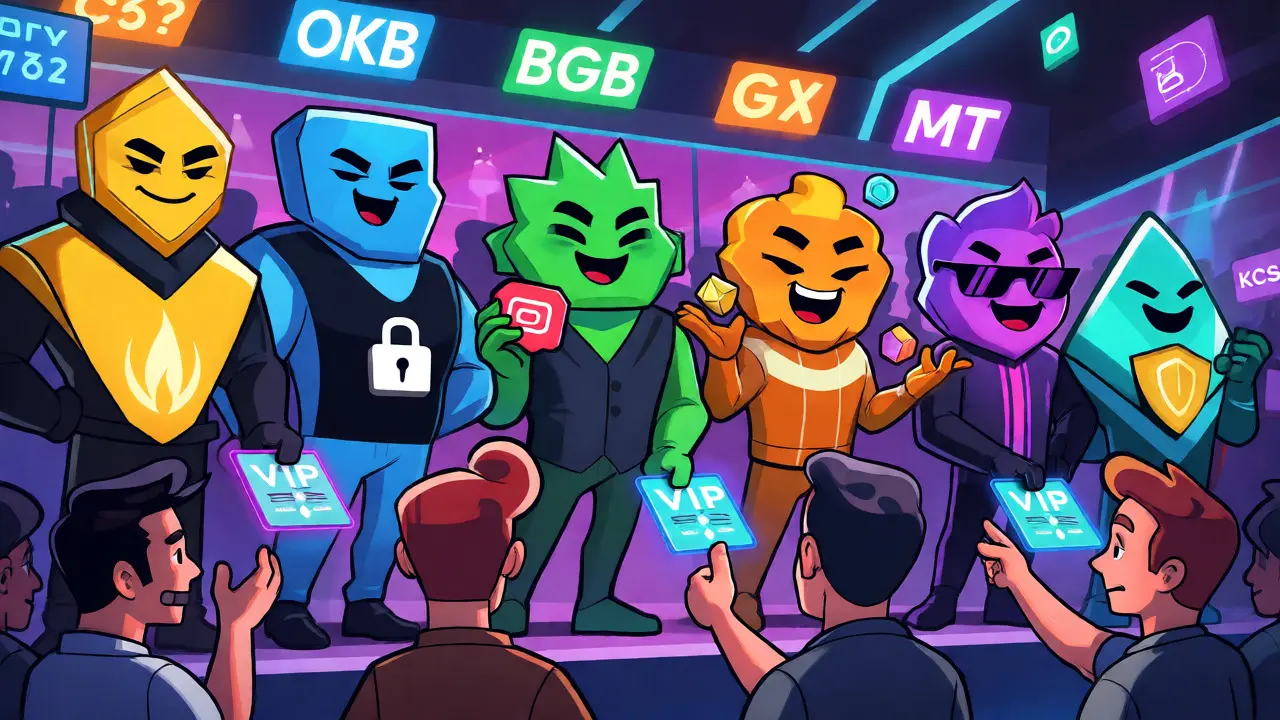
You’re staring at your portfolio. You see Bitcoin, Ethereum, maybe some altcoins. But there’s a weird category sitting there, often ignored by newbies but hoarded by pros: Exchange Tokens. These aren’t just random coins; they are the native currencies of centralized exchanges like Binance, OKX, and KuCoin. Think of them as the VIP passes to a club. Hold the pass, and you get discounts, staking rewards, and early access to new projects. Miss out on the pass, and you pay full price for every trade.
But which pass is worth buying? Is BNB still king despite regulatory drama? Does OKB’s fixed supply beat BNB’s burn model? Or are newer players like BGB and MX offering better value because they’re hungrier? As of late 2025, these tokens control roughly $120 billion in market cap. Choosing wrong isn’t just about missing gains; it’s about paying more fees and missing ecosystem perks. Let’s break down the real differences between the big six: BNB, OKB, BGB, MX, GT, and KCS.
The Economics of Scarcity: Burns vs. Fixed Supply
Most people think exchange tokens are all the same. They aren’t. The way a token manages its supply determines its long-term value proposition. There are two main strategies here: aggressive burning or strict scarcity.
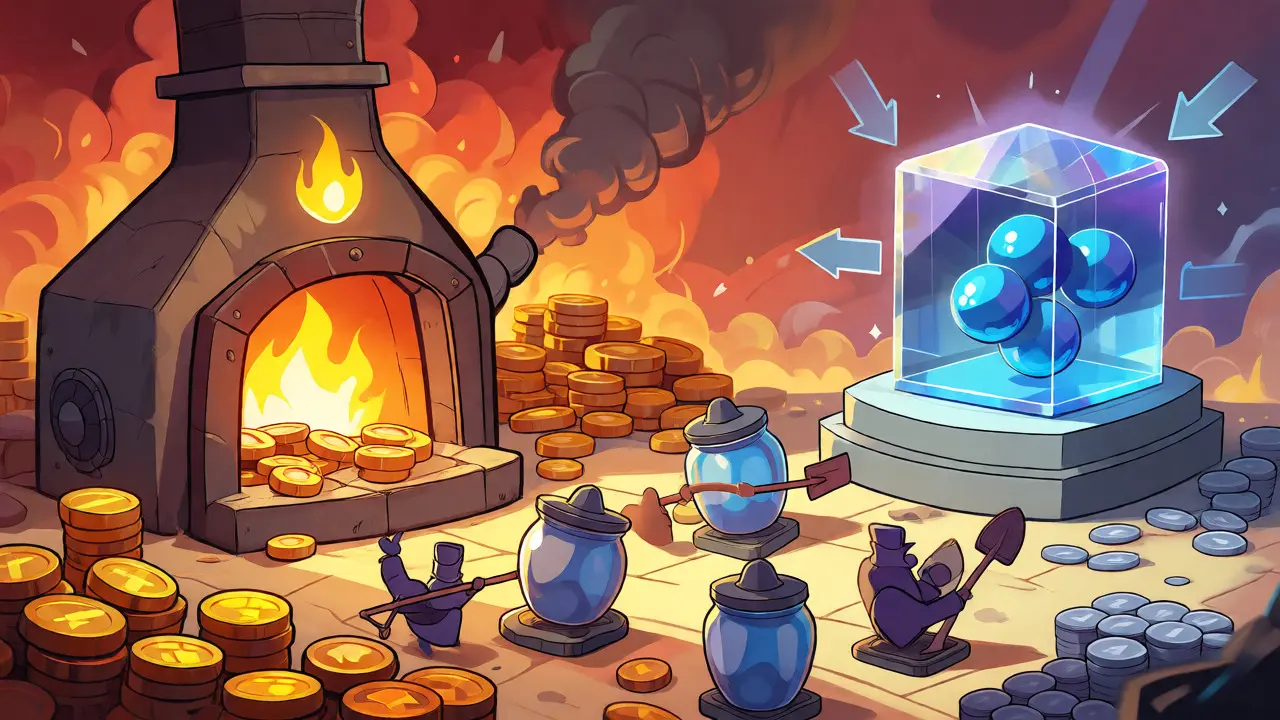
BNB uses a quarterly burn mechanism. Binance takes 20% of its profits, buys back BNB from the open market, and sends it to a dead address. This reduces supply over time until half of the original 200 million tokens are gone. By Q3 2025, 45.6% of BNB had been burned. It’s a deflationary model tied directly to exchange success. If Binance makes money, BNB becomes scarcer.
OKB takes a different route. It has a hard-capped supply of 21 million tokens. No new tokens will ever be created. To add scarcity, OKX uses 30% of profits for buybacks, reducing circulating supply by 12.3% since 2023. Dr. Garrick Hileman from Blockchain.com noted that this fixed-supply model creates stronger scarcity dynamics than BNB’s variable burn, potentially leading to better long-term retention.
Then you have BGB (Bitget) and KCS (KuCoin). Bitget burns 50% of revenue quarterly, having already destroyed 2.5 billion tokens. KuCoin burns 50% of daily trading fees, a more frequent but smaller-scale destruction. GT (Gate.io) also burns 20% of platform revenue. MX (MEXC) caps supply at 100 million and uses 50% of revenue for buybacks. The takeaway? Verify the burn rate. Messari data shows tokens with verifiable burns outperformed those without by 23.7% over 18 months.
Utility Beyond Discounts: What Do You Actually Get?
Trading fee discounts are the entry drug. BNB offers up to 25% off, OKB gives 40%, and MX boasts a massive 50% discount. But if that’s all you look at, you’re missing the point. The real value lies in ecosystem integration.
BNB is the most integrated. It powers the BNB Chain, which processes 3.2 million daily transactions. You use BNB for gas fees, staking, and participating in Launchpads. In October 2025, Binance launched BNB Greenfield for decentralized storage, attracting 1.2 million users. It’s not just a coin; it’s fuel for a whole network.
OKB shines in DeFi. With 412 dApps built on OKC (OKX Chain), holding OKB gives you governance rights and access to lending pools that processed $1.7 billion in TVL recently. If you’re into Decentralized Finance, OKB might offer more practical utility than BNB’s broad but sometimes shallow reach.
BGB has carved a niche in social trading. Its integration with Morph Blockchain supports copy-trading features dominant in Asia. Analyst Wendy O points out that BGB’s connection to Bitget’s copy-trading dominance gives it unique utility traditional tokens lack. If you copy-trade, BGB is practically essential.
MX leverages MEXC’s massive asset selection-2,690 spot pairs. Holding MX unlocks higher leverage limits and exclusive access to new listings before they hit other exchanges. For altcoin hunters who want exposure to obscure gems, MX is a powerful tool.
Market Position and Regional Dominance
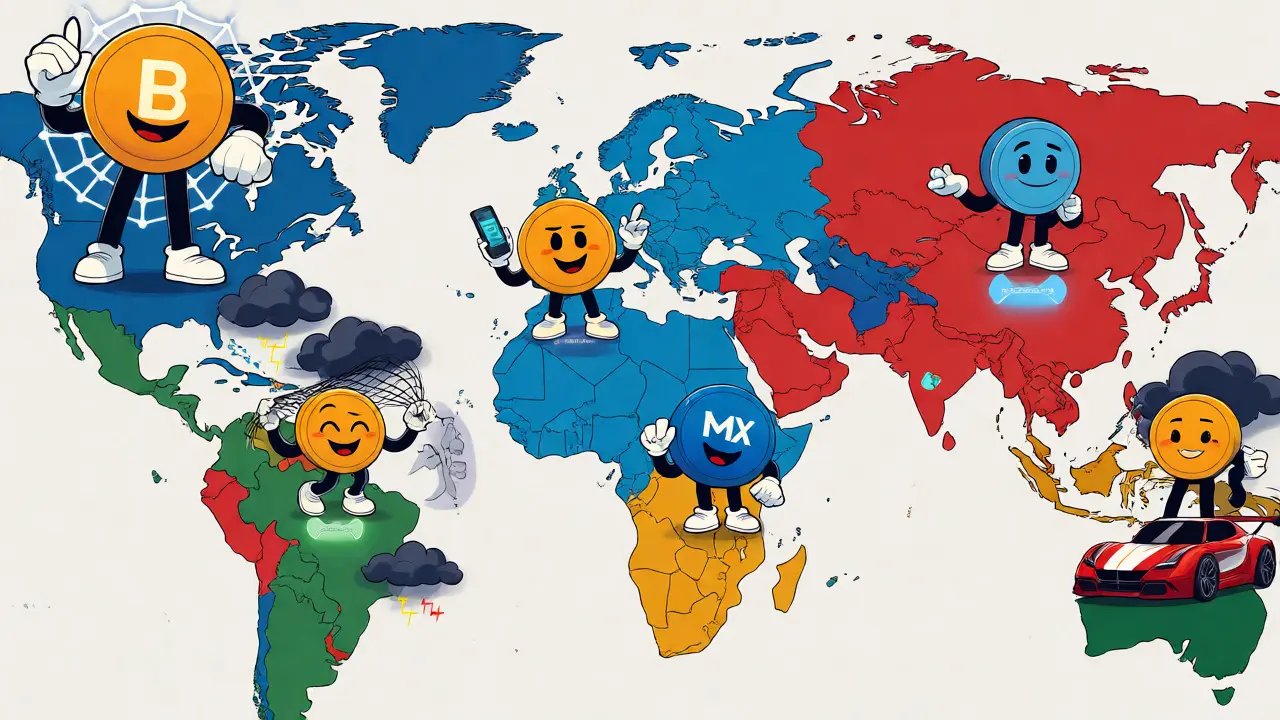
Where you live matters. These tokens don’t compete evenly everywhere. BNB dominates North America (58.3% share) and Europe (49.7%). If you’re in the US or EU, BNB has the deepest liquidity and most institutional support, despite regulatory headwinds.
In Southeast Asia, BGB leads with a 63.2% market share. Bitget’s focus on Asian markets and mobile-first UX resonates there. In Latin America, MX dominates with 51.4% share, thanks to aggressive marketing and low fees for local fiat ramps.
GT has a strong foothold in the Middle East, aided by Gate.io’s VARA license in Dubai and high-visibility sponsorships like Oracle Red Bull Racing. This regional strength translates to stable demand and community loyalty in specific zones.
| Token | Supply Model | Max Fee Discount | Key Ecosystem Feature | Regional Strength |
|---|---|---|---|---|
| BNB | Quarterly Burn (20% profit) | 25% | BNB Chain & Greenfield Storage | Global / NA / EU |
| OKB | Fixed Supply + Buyback | 40% | OKC DeFi & Governance | Global / APAC |
| BGB | Quarterly Burn (50% revenue) | 20% | Copy-Trading & Morph Chain | Southeast Asia |
| MX | Capped Supply + Buyback | 50% | Altcoin Access & NFT Marketplace | Latin America |
| GT | Quarterly Burn (20% revenue) | 20% | GateChain Cross-Swap | Middle East |
| KCS | Daily Fee Burn (50%) | 20% | Protection Fund & AI Bots | Global / Niche |
Risks: Regulation and Centralization
Here’s the catch. Exchange tokens are inherently centralized. You trust the exchange not to rug-pull you, not to freeze your funds, and not to change the rules overnight. Regulatory scrutiny is tightening. The SEC’s November 2025 guidance suggested some exchange tokens could be classified as securities if their utility is deemed insufficient. That’s a scary thought for holders of tokens with weak ecosystems.
BNB faced significant backlash after Binance’s settlement with US regulators in late 2024. While it survived, the uncertainty lingers. OKB faces challenges under MiCA compliance in Europe. KCS suffered a sentiment drop after a service disruption in February 2025, reminding us that technical failures can hit token prices hard.
Always check the proof-of-reserves. Since January 2025, 89% of major platforms publish monthly reserves due to European regulations. If an exchange doesn’t show its work, walk away.
Which Token Should You Pick?
It depends on your style. Are you a high-volume trader? Look at fee discounts. MX offers 50%, OKB 40%. Are you a DeFi user? OKB and BNB have the best chain integrations. Are you in Asia? BGB might give you better support and localized features. Are you hunting obscure altcoins? MX’s listing speed is unmatched.
Don’t put all your eggs in one basket. Many pros hold a mix. Maybe 50% BNB for stability and ecosystem breadth, 30% OKB for DeFi yield, and 20% in a regional favorite like BGB or MX for alpha. Watch the burn rates. A token with a shrinking supply and growing usage is a safer bet than one with inflationary pressure and stagnant volume.
Are exchange tokens good investments?
They can be, but they carry specific risks. Their value is tied to the success of the exchange. If the exchange grows, the token usually appreciates due to buybacks and increased utility. However, they are exposed to regulatory risks and platform-specific failures, unlike Bitcoin or Ethereum which are independent of any single company.
What is the main difference between BNB and OKB?
The core difference is supply management. BNB uses a quarterly burn based on profits, aiming to reduce supply over time. OKB has a fixed maximum supply of 21 million tokens, relying on buybacks to reduce circulating supply. BNB has broader global adoption, while OKB is often praised for its stricter scarcity model and strong DeFi integration on OKC.
Do I need to hold exchange tokens to use the exchange?
No, you can trade without them. However, holding them provides significant benefits, such as reduced trading fees (often 20-50%), access to exclusive token sales (Launchpads), staking rewards, and sometimes voting rights on new listings. Not holding them means paying higher fees and missing out on ecosystem perks.
Which exchange token has the highest fee discount?
As of late 2025, MEXC (MX) offers the highest potential discount at up to 50% for holders, followed closely by OKX (OKB) at 40%. Binance (BNB) typically offers around 25%. Always check current tier structures, as discounts often depend on your trading volume and holding amount.
Is there a risk of exchange tokens becoming securities?
Yes. Regulators like the SEC are scrutinizing whether exchange tokens provide sufficient utility beyond just being a medium of exchange or investment contract. If a token is deemed a security, it could face delisting from certain jurisdictions or stricter compliance requirements, impacting liquidity and price.