
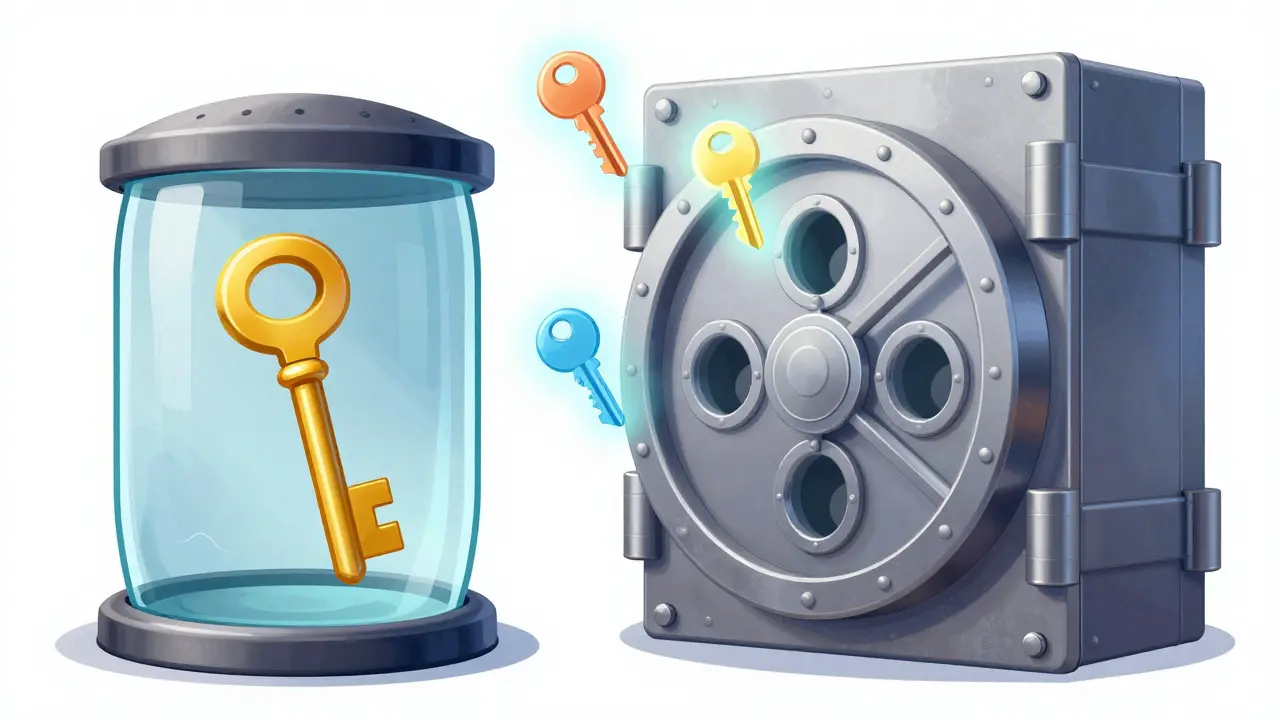
If you are managing a significant amount of capital or running a business, relying on one person (or one device) is a massive risk. Whether it's a phishing attack, a lost seed phrase, or an internal employee gone rogue, the danger is always there. MultiSig changes the game by requiring a consensus before any money moves.
How MultiSig Actually Works: The M-of-N Logic
To understand the magic of multisig, you have to understand the "M-of-N" setup. In a standard wallet, you have one key. If you have it, you have the money. In a MultiSig Wallet, you define a set of total keys (N) and a minimum number of signatures required to approve a transaction (M).
Let's look at a few common real-world setups:
- 2-of-3 Configuration: You have three keys. Maybe one is on your laptop, one is on a hardware wallet in your safe, and one is held by a trusted partner. To send funds, any two of these three keys must sign off. If you lose one key, you can still move your funds using the other two. If a hacker steals one, they still can't touch your money.
- 3-of-5 Configuration: Common for companies or DAOs (Decentralized Autonomous Organizations). This requires three different people to agree before a transaction is broadcast to the network. It's a powerful way to prevent any single person from making a catastrophic mistake or stealing funds.
This process happens via Smart Contracts. The contract acts as the gatekeeper, holding the assets in a pending state until the required number of digital signatures are collected. Only then does the blockchain execute the transfer.
| Feature | Single-Signature Wallet | MultiSig Wallet |
|---|---|---|
| Point of Failure | Single (One key lost = funds lost) | Distributed (Multiple keys needed) |
| Theft Protection | Low (One leak is fatal) | High (Hacker needs multiple keys) |
| Operational Speed | Instant (One person signs) | Slower (Requires coordination) |
| Complexity | Simple setup | Higher technical requirement |
Closing the Security Gaps
Why is this so much better than just having a few different wallets? Because MultiSig doesn't just hide your money; it changes the rules of access. Let's break down the specific threats it neutralizes.
First, consider phishing attacks. We've all seen the fake emails or websites that trick you into entering your seed phrase. If you use a single-sig wallet, the game is over the moment you hit "submit." With a 2-of-3 MultiSig, the attacker only gets one key. They can't move the funds without a second signature, giving you time to realize the breach and move the assets using your remaining keys.
Then there's the insider threat. In a corporate setting, giving one treasurer total control over the company's treasury is a recipe for disaster. MultiSig forces a check-and-balance system. No single employee can drain the account; they need a quorum of executives to sign off on the spend.
Finally, it solves the "lost key" nightmare. We've all heard stories of people throwing away hard drives containing thousands of Bitcoins. In a MultiSig setup, redundancy is built-in. If you have a 2-of-3 setup and lose one hardware wallet, your funds aren't gone. You simply use your other two keys to recover the assets to a new wallet.

Who Should Actually Use This?
MultiSig is a powerhouse, but it's not for everyone. If you're just buying $50 of crypto to experiment, the complexity might be overkill. However, it's essential for specific groups:
- High-Net-Worth Individuals: If your holdings are life-changing, the extra five minutes it takes to coordinate signatures is a small price to pay for peace of mind.
- Project Developers: Any Smart Contract that controls a treasury should never be owned by a single account. Using a MultiSig ensures that a single compromised developer account doesn't lead to a total protocol drain.
- Escrow Services: MultiSig is perfect for trustless trades. A buyer, a seller, and an arbiter can set up a 2-of-3 wallet. The funds are released when two of the three agree the conditions of the sale were met.
- DAOs: Decentralized governance relies on the fact that no one person is the boss. MultiSig wallets allow the community to vote and execute treasury spends based on a majority.

Practical Implementation and Pitfalls
Setting this up isn't as simple as downloading an app and clicking "create." You need a strategy for private key management. If you store all your MultiSig keys on the same laptop, you've just created a more complex version of a single-sig wallet. The security only exists if the keys are physically and digitally separated.
For the best protection, combine Hardware Wallets (like Ledger or Trezor) with your MultiSig setup. By keeping keys on offline devices, you prevent remote hackers from ever reaching the required threshold of signatures.
Be aware of the "operational tax." MultiSig wallets take longer to use. You can't just click a button and send funds instantly; you have to wait for your partners to sign, or move between your own devices. This is a feature, not a bug-speed is the enemy of security.
Also, keep an eye on the tools you use. Some platforms, like Trust Wallet, have integrated security scanners that analyze transactions for phishing and malware in real-time. Combining these scanners with a MultiSig setup gives you both a "shield" (the scanner) and a "vault" (the multisig).
Is MultiSig safer than a hardware wallet?
It's not necessarily "better," but different. A hardware wallet protects a single key from online attacks. MultiSig protects the funds by requiring *multiple* keys. The safest approach is using hardware wallets as the keys within a MultiSig setup.
Can I change the number of signers later?
Depending on the wallet implementation (like Gnosis Safe or others), you can often update the signers or the threshold. However, this usually requires the current majority of signers to approve the change.
What happens if I lose the majority of my keys?
This is the biggest risk. If you have a 2-of-3 setup and lose two keys, the funds are permanently inaccessible. There is no "forgot password" button in blockchain. This is why backing up seed phrases on physical materials in separate locations is non-negotiable.
Does MultiSig cost more in transaction fees?
Yes. Because MultiSig relies on smart contracts and requires multiple signatures to be processed on-chain, the gas fees (transaction costs) are typically higher than a simple single-signature transfer.
Can I use MultiSig for small amounts of money?
You can, but the setup time and higher fees usually make it impractical for small sums. It's best reserved for long-term savings (HODLing) or business operations.
Next Steps for Securing Your Assets
If you're ready to move away from the risk of single-sig wallets, start small. Don't move your entire portfolio at once. Try setting up a 2-of-3 wallet with a small amount of funds to understand the coordination process.
For individuals: Set up one key on a hardware device, one on a secure mobile app, and a third backup key stored in a physical vault or with a legal professional. This ensures you have a recovery path if one device fails.
For businesses: Establish a clear internal policy on who holds the keys. Use a 3-of-5 setup so that the business can still function even if one or two key-holders leave the company or lose their devices. Always use professional-grade tools and integrate real-time security scanning to catch threats before they even reach the signature stage.


Gloris Young
Super helpful breakdown! 🌟