
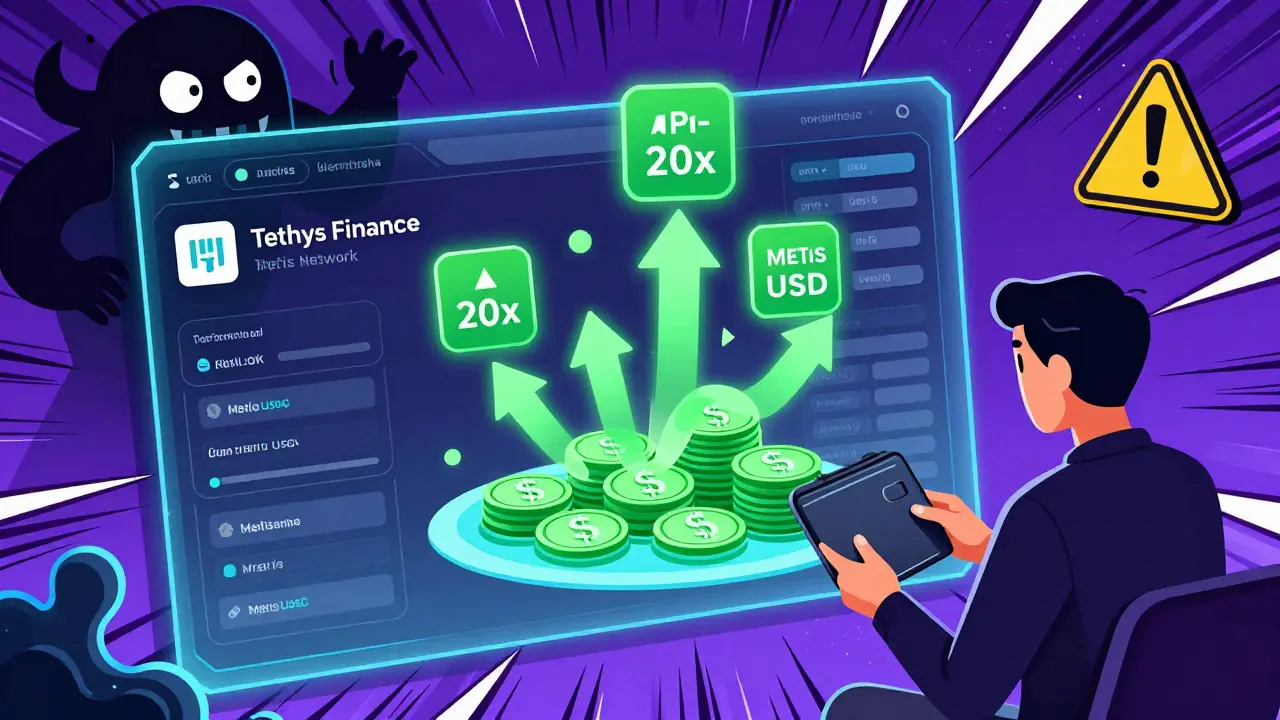
When you hear "crypto exchange," you probably think of Binance, Coinbase, or Kraken - platforms where you buy, sell, and trade coins like Bitcoin and Ethereum. But Tethys isn’t one of those. It doesn’t let you swap tokens like a typical exchange. Instead, Tethys Finance is a decentralized leveraged yield protocol built on the Metis Andromeda Layer 2 network. If you’re looking for a place to trade, you’re in the wrong place. But if you want to boost your crypto yields with leverage - up to 20x - then Tethys might be worth your attention.
What Is Tethys Finance?
Tethys started in 2022 as a decentralized exchange (DEX) on Metis, aiming to be the go-to trading platform for users on that network. But by late 2023, they made a bold pivot: they shut down their DEX entirely and refocused on something more specialized - leveraged yield farming. Today, Tethys Finance V2 is all about letting users borrow liquidity provider (LP) tokens to amplify their farming rewards.
Here’s how it works: say you have METIS-USDC liquidity tokens from a Uniswap-style pool on Metis. Instead of just staking them for a 40% APY, you can use them as collateral to borrow more LP tokens. Then, you stake those borrowed tokens too. The result? Your yield can jump from 40% to 180% or more - depending on market conditions and how much leverage you use.
This isn’t magic. It’s math. And it comes with serious risks. If the price of METIS drops, your position can get liquidated. You lose part - or all - of your stake. Tethys doesn’t protect you from market moves. It just gives you more power to amplify gains… or losses.
How Tethys Stands Out: Shared Liquidity Pools
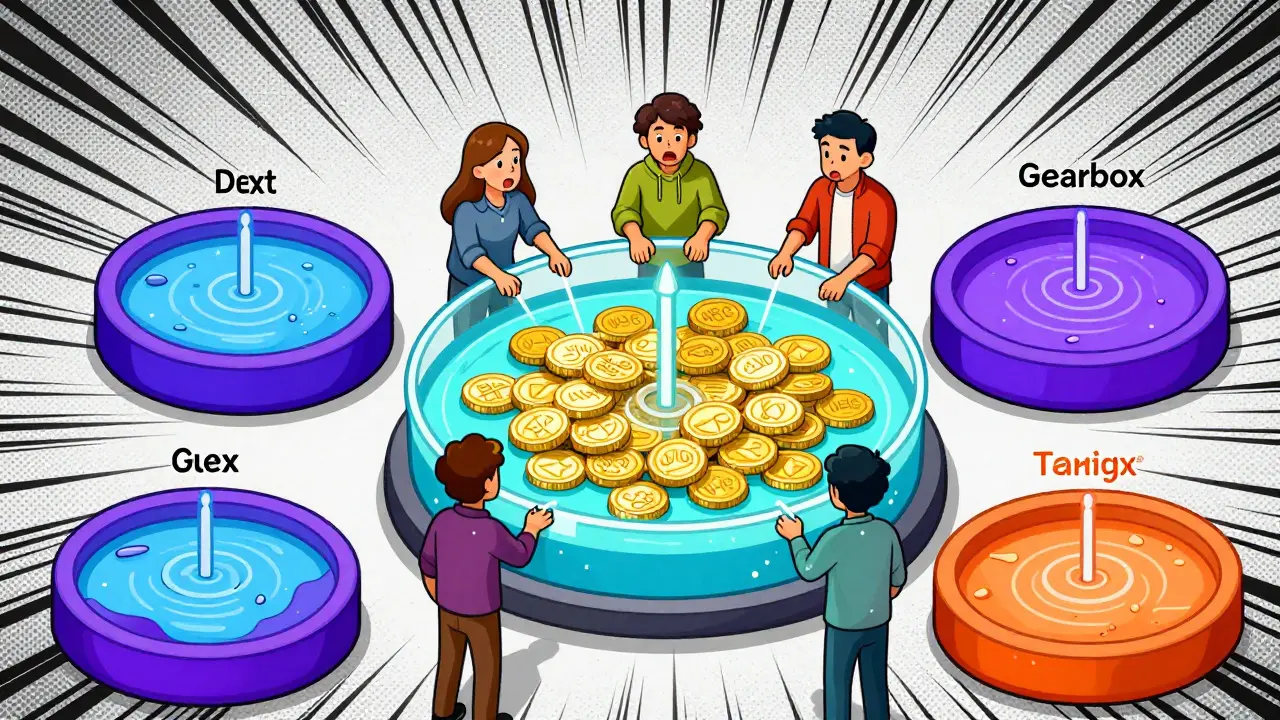
Most leveraged yield platforms like Tarot or Gearbox lock liquidity into isolated pools. That means if you want to farm METIS-USDC on Tethys, you’re stuck with just that one pool. But Tethys introduced something different: shared borrowable pools.
Imagine five different DEXes on Metis all have METIS-USDC pools. Normally, each one needs its own liquidity. That splits the capital. Tethys combines them into one big pool. So when you borrow, you’re tapping into deeper liquidity. This reduces slippage and makes large positions more feasible - at least in theory.
It’s a smart fix for a real problem. Metis doesn’t have the liquidity of Ethereum or Arbitrum. By pooling resources, Tethys makes better use of what’s available. But there’s a trade-off: if one pool gets hacked or exploits, the whole shared system could be at risk. DeFi Safety’s lead analyst Alexander Smirnov warned in September 2024 that this model introduces systemic risk - a single point of failure.
Performance and Market Position
As of October 2025, Tethys Finance has about $48.7 million locked in its protocols, according to DeFiLlama. That makes it the third-largest leveraged yield app on Metis - behind Metavault Trade and Netswap. The entire Metis ecosystem holds around $320 million in total value locked (TVL), which is less than 1% of Ethereum’s DeFi market.
Tethys’s native token, TETHYS, has a fixed supply of 6.15 million. All of it is circulating. That’s rare in crypto - no inflation, no team allocations, no vesting. The token is used for governance, but voting power is still centralized in the hands of the development team. A full transition to decentralized governance is planned for Q1 2026.
On CoinGecko, Tethys ranks #2,847 by market cap. That’s tiny. It’s not a household name. But within its niche - Metis-based leveraged yield - it’s one of the most active tools. DappRadar recorded about 1,200 daily active users in June 2025. That’s not much compared to big platforms, but it’s a dedicated group.
User Experience: Easy to Start, Hard to Master
Setting up your first leveraged position on Tethys takes about 5 to 7 minutes if you’ve used DeFi before. You connect your wallet - MetaMask, Rabby, or Metis Wallet - approve the TETHYS token, pick your leverage ratio (up to 20x), and click "Farm." The interface is clean. No sign-up. No KYC. No passwords. Just wallet access.
But here’s the catch: most users don’t understand what leverage really means. A 10x position doesn’t mean you make 10x more. It means you borrow 9x your own capital. If the underlying asset drops 10%, you’re wiped out. And because Metis has shallow liquidity, slippage during price swings can be brutal.
Reddit user "DeFi_Degens_2024" wrote in August 2025: "Tethys boosted my APY from 45% to 180%, but slippage was brutal during the last market dip." That’s the reality. High returns come with high pain.
Documentation is thin. Tethys has 28 help articles. Compare that to Aave’s 120+ pages. If you’re new to DeFi, you’ll struggle. The Metis Academy rated Tethys a 3.5/5 in difficulty - not beginner-friendly.
Risks You Can’t Ignore
There are three big dangers with Tethys:
- Liquidation risk: High leverage means your position can vanish in minutes if prices move against you.
- Ecosystem dependency: Tethys only works on Metis. If Metis loses users or TVL, Tethys dies with it. Metis is growing, but slowly. It’s still behind Arbitrum, Optimism, and Polygon.
- Regulatory gray zone: The SEC flagged leveraged yield protocols with >5x leverage in September 2024 as potentially falling under securities laws. Tethys hasn’t been targeted - yet. But regulators are watching.
Delphi Digital’s August 2025 analysis called Tethys "promising but risky," citing both its innovation and its fragility. If Metis grows tenfold, Tethys could become essential. If it stalls, Tethys fades into obscurity.

Who Is Tethys For?
Tethys isn’t for beginners. It’s not for casual investors. It’s not for those who want to buy Bitcoin and hold.
Tethys is for:
- Intermediate DeFi users who already farm yield on Metis
- Those who understand liquidation mechanics and risk management
- People who believe in Metis Andromeda’s long-term growth
- Traders who want to maximize returns without leaving the Metis ecosystem
If you’re looking for a simple way to earn 8% on stablecoins? Look elsewhere. If you’re chasing 150% APY on METIS-USDC and you’ve got skin in the game? Tethys is one of the few tools that lets you do it - on-chain, permissionless, and without a middleman.
Final Verdict: Niche Tool, High Reward, High Risk
Tethys Finance isn’t a crypto exchange. It’s a leveraged yield engine built for a specific chain. It’s not trying to compete with Binance. It’s trying to make Metis more powerful.
Its shared liquidity pools are genuinely clever. Its focus is sharp. And its tokenomics are transparent. But its user base is small. Its liquidity is thin. And its risks are real.
If you’re already active on Metis and understand the mechanics of leverage - go ahead. Try a small position. Start with 3x or 5x. Don’t go all-in.
If you’re new to DeFi? Learn Uniswap first. Master staking. Understand slippage and impermanent loss. Then come back.
Tethys isn’t for everyone. But for the right user - it’s one of the most interesting tools in DeFi right now.
Is Tethys a crypto exchange?
No, Tethys is not a crypto exchange. It doesn’t allow direct token swaps like buying ETH for USDC. Instead, it’s a leveraged yield farming protocol that lets users borrow LP tokens to amplify their farming rewards on the Metis network.
What is the TETHYS token used for?
The TETHYS token is the native governance token of Tethys Finance. It’s used for voting on protocol upgrades and future changes. Currently, voting power is held by the development team, but a full transition to decentralized governance is planned for Q1 2026. The token has a fixed supply of 6.15 million, with no inflation.
Can I lose money using Tethys?
Yes, you can lose money - even all of your funds. Tethys allows leverage up to 20x. If the price of the underlying asset (like METIS) drops, your position can be automatically liquidated. High leverage magnifies both gains and losses. Users with 10x+ positions have lost entire stakes during market corrections.
Is Tethys safe?
Tethys hasn’t been hacked, and its smart contracts are publicly audited. However, safety depends on two things: the security of the Metis network and the risk of systemic failure in its shared liquidity pools. DeFi Safety warns that if one pool is compromised, the shared model could expose the entire protocol. Use only what you can afford to lose.
Do I need KYC to use Tethys?
No. Tethys is non-custodial. You connect your wallet - like MetaMask or Metis Wallet - and interact directly with the smart contracts. No personal information, no identity verification. That’s standard for DeFi, but it also means you’re fully responsible for your funds.
How does Tethys compare to Tarot or Gearbox?
Tarot (on Fantom) and Gearbox (on multiple chains) offer similar leveraged yield features. But Tethys is unique because it’s built exclusively for Metis Andromeda. This gives it deeper integration and better capital efficiency within that ecosystem, but it limits access to users outside Metis. Tarot and Gearbox have larger user bases and more liquidity, but Tethys offers a more focused, ecosystem-specific solution.
What’s the minimum amount to start using Tethys?
There’s no official minimum, but most users start with $100-$500 worth of METIS-USDC LP tokens. Smaller amounts are possible, but with shallow liquidity on Metis, tiny positions often suffer from high slippage and low returns. For meaningful yield amplification, $500+ is recommended.
Can I withdraw my funds anytime?
Yes, you can withdraw at any time. But if you have an open leveraged position, you must first close it - meaning you repay your borrowed LP tokens plus interest. You can’t just pull out your collateral while still borrowing. The process takes a few minutes and requires gas fees on Metis.
Is Tethys available on mobile?
Tethys doesn’t have a native mobile app. But you can access it through mobile wallets like MetaMask or Rabby. The website is responsive and works on smartphones. However, managing leveraged positions on a small screen is risky. Most experienced users recommend using a desktop for safety and clarity.
What’s next for Tethys?
The team plans to fully decentralize governance in Q1 2026, handing control of the protocol to TETHYS token holders. They’re also working on expanding to additional asset pairs beyond METIS-USDC. Long-term, they hope to integrate with other L2s - but for now, they remain focused on making Metis Andromeda the best place for leveraged yield farming.
For those who understand the risks and are already active on Metis, Tethys offers one of the most powerful yield tools in the L2 space. For everyone else? Stick to the basics - and learn before you leverage.


christopher luke
This is actually kinda cool 😎 I started with 5x leverage on METIS-USDC and my APY went from 42% to 160% in two weeks. Yeah, I got liquidated once during the dip, but I learned. Now I only use 3x and keep 20% cash on the side. DeFi is a game of patience, not greed.